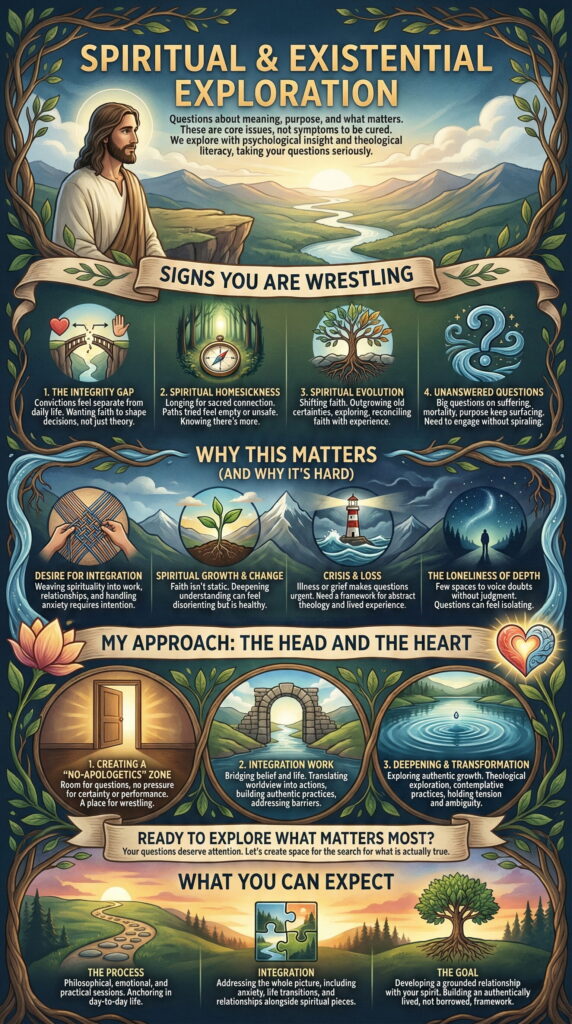
Spiritual & Existential Exploration
Questions about meaning, purpose, and what matters when everything else falls away.
These aren’t side issues, and they won’t be treated like symptoms to be “cured.”
We explore existential concerns and the search for significance with both psychological insight and theological literacy. Whether you are deepening your faith, navigating a “dark night of the soul,” or trying to integrate what you believe into how you actually live, your questions get taken seriously here.
Join Sean Lewis for 50 minutes to discuss your story and map a path forward

Signs You Are Wrestling
Existential struggles don’t always announce themselves clearly. They often show up as background unease; a sense that the old answers aren’t working anymore.
You might recognize these experiences:
- The Integrity Gap: You have spiritual convictions, but they feel separate from your daily life. You want your faith to shape your decisions and relationships, not just exist as an abstract theory.
- Spiritual Homesickness: You are longing for connection with the sacred, but the paths you’ve tried feel empty, performative, or unsafe. You know there’s more, but you can’t seem to access it.
- The Meaning Crisis: Success, comfort, or achievement aren’t delivering what you expected. You keep asking “Is this it?” or “What’s the point?” and the standard answers; career advancement, material comfort, checking boxes; feel hollow.
- Unanswered Questions: Big questions about suffering, mortality, or purpose keep surfacing. You can’t ignore them, but you don’t know how to engage with them without spiraling.
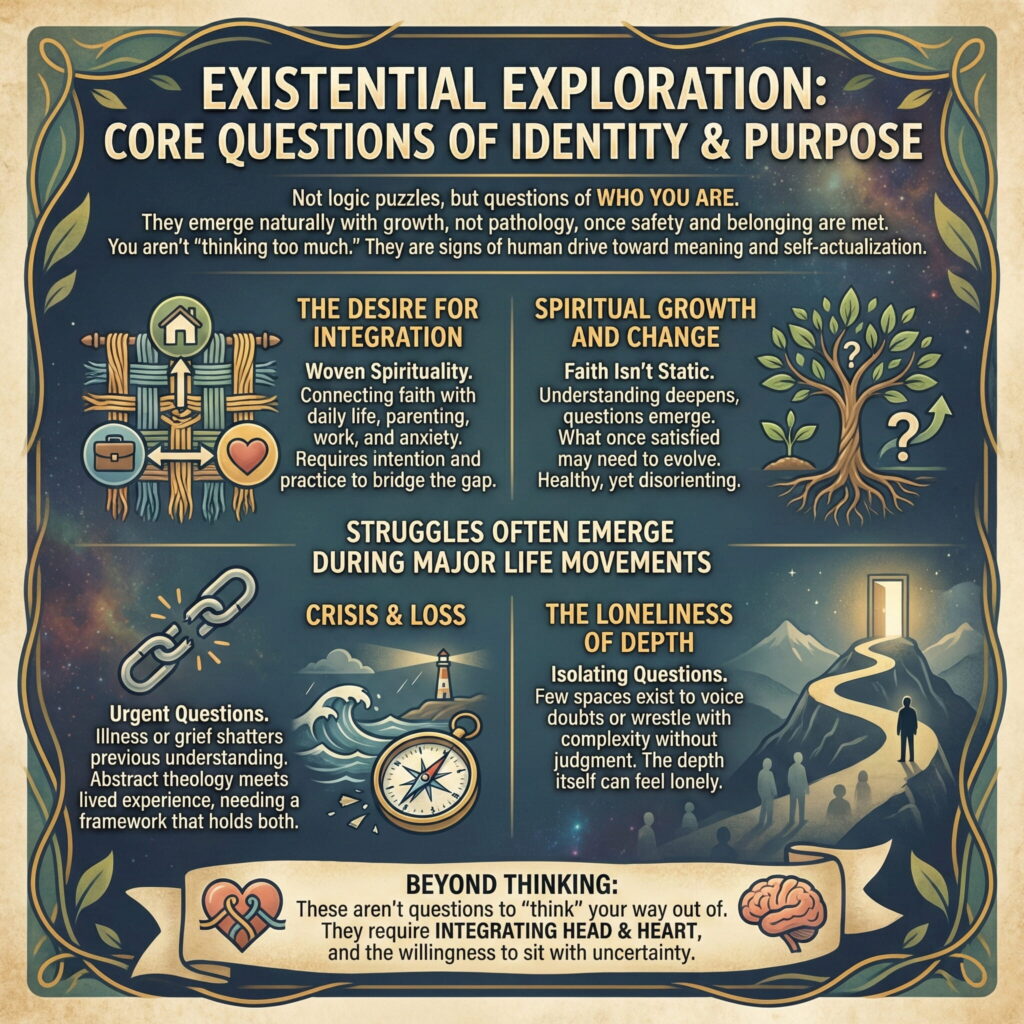
Why This Matters (And Why It's Hard)
Existential questions strike at the core of who you are. They can’t be solved with logic alone because they aren’t math problems; they are questions of identity, purpose, and how to live in the face of uncertainty.
These experiences share a common thread: your inner life is outpacing the frameworks you’ve been given. You need space to build something more honest, more durable, and more yours.
These struggles often emerge during major life movements:
- When Belief Systems Shift: You’re outgrowing old certainties, exploring new practices, or trying to reconcile faith with experiences that don’t fit the narrative you were given. The framework that once organized your world is cracking, and you need space to rebuild without losing yourself in the process.
- Developmental Transitions: Major life stages; becoming a parent, midlife reassessment, retirement, approaching mortality; force you to reckon with purpose and legacy. What mattered before might not be enough now, and you’re searching for what comes next.
- Crisis & Loss: When illness or grief shatters your previous understanding of how the world works, spiritual questions become urgent. Abstract theology meets lived experience, and you need a framework that holds both.
- The Loneliness of Depth: Most people don’t have spaces where they can voice doubts, wrestle with complexity, or explore spiritual questions without judgment. The questions themselves can feel isolating.
These aren’t questions you can think your way out of. They require a different kind of work; one that integrates head, heart, and the willingness to sit with uncertainty.
My Approach: The Head and The Heart
I bring both clinical expertise and spiritual literacy to the room. This means your questions deserve more than platitudes or premature answers.
1. Creating a “No-Apologetics” Zone We make room for the questions you’ve been afraid to voice. There is no pressure to reach certainty, perform faith, or defend your doubts. This is a place for wrestling, not performing.
2. Integration Work If there is a gap between what you believe and how you live, we bridge it.
- Translation: How does your worldview inform how you handle conflict, money, parenting, or anxiety?
- Building practices: Finding spiritual disciplines that actually connect you to the sacred, not just ones you think you “should” do
- Addressing barriers: We examine what gets in the way—shame, busyness, disconnection, fear, or religious trauma
3. Deepening & Transformation We explore what spiritual growth looks like for you, not what it’s supposed to look like according to someone else’s map. This might involve:
- Theological exploration: Examining questions about God, suffering, prayer, or doubt with both intellectual rigour and emotional honesty
- Contemplative practices: Learning or deepening practices like meditation, silence, sacred reading, or embodied prayer
- Holding tension: Developing the capacity to live with ambiguity, to hold paradox without collapsing it, and to find meaning even when clarity isn’t available
Note: I am not here to tell you what to believe. I am here to help you think deeply, feel honestly, and find your own authentic path forward.
Ready to explore what matters most?
Your questions deserve serious attention. Let’s create space for the wrestling, the longing, and the search for what is actually true.
Assessment, goal-setting, and your personalized plan.

What You Can Expect
This work is less about reaching a final “answer” and more about developing the capacity to engage with life’s deepest questions without fear.
The Process: Some sessions will feel philosophical or theological. Others will touch on grief, longing, or anger. Sometimes we’ll explore concrete practices to anchor you in your day-to-day life.
Integration with Other Issues: Existential questions often show up alongside anxiety, depression, life transitions, or relational struggles. We’ll address the whole picture, not just the spiritual pieces in isolation.
The Goal: You won’t necessarily land on perfect certainty. But you will develop a grounded relationship with your own spirit. You will build a framework that is yours—not borrowed, not performed, but authentically lived.
Page Summary