Grief & Loss
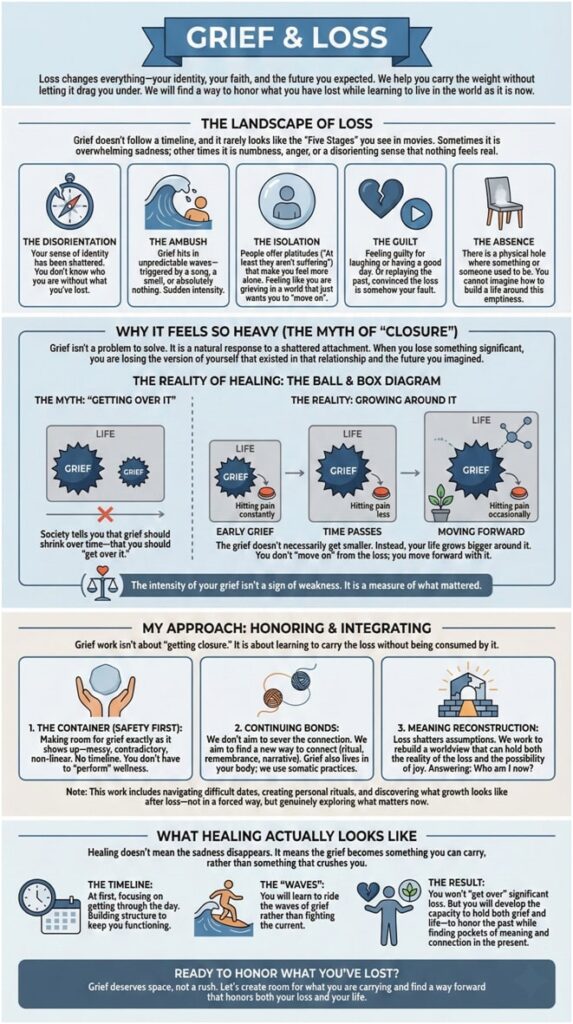
Loss changes everything—your identity, your faith, and the future you expected.
We help you carry the weight without letting it drag you under. We will find a way to honour what you have lost while learning to live in the world as it is now.
Join Sean Lewis for 50 minutes to discuss your story and map a path forward

The Landscape of Loss
Grief doesn’t follow a timeline, and it rarely looks like the “Five Stages” you see in movies. Sometimes it is overwhelming sadness; other times it is numbness, anger, or a disorienting sense that nothing feels real.
If you are reading this, you might recognize these experiences:
- The Disorientation: Your sense of identity has been shattered. You don’t know who you are without what you’ve lost.
- The Ambush: Grief hits in unpredictable waves—triggered by a song, a smell, or absolutely nothing at all. You thought you were doing better, and then suddenly you aren’t.
- The Isolation: People offer platitudes (“At least they aren’t suffering”) that make you feel more alone. You feel like you are grieving in a world that just wants you to “move on.”
- The Guilt: You feel guilty for laughing, or for having a good day. Or you replay the past, convinced the loss is somehow your fault.
- The Absence: There is a physical hole where something or someone used to be. You cannot imagine how to build a life around this emptiness.
Why It Feels So Heavy (The Myth of "Closure")
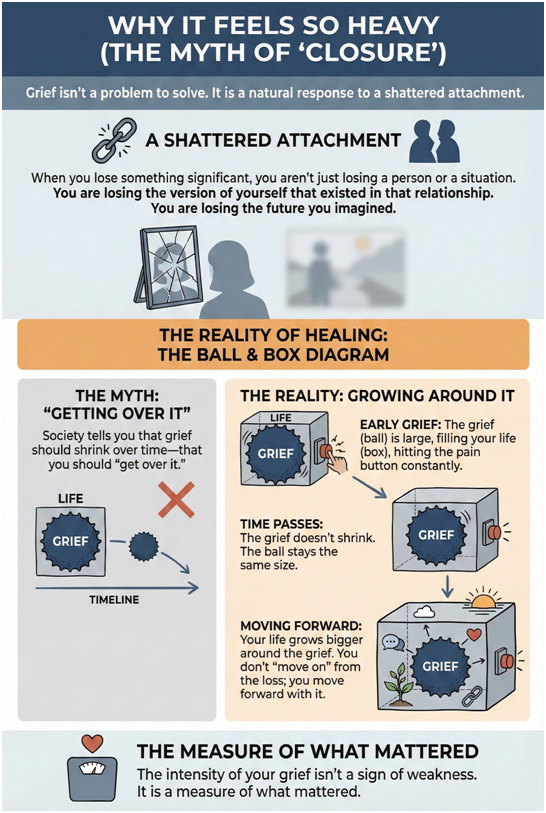
Grief isn’t a problem to solve. It is a natural response to a shattered attachment.
When you lose something significant, you aren’t just losing a person or a situation. You are losing the version of yourself that existed in that relationship. You are losing the future you imagined.
Society tells you that grief should shrink over time—that you should “get over it.” But real grief doesn’t shrink.
The Reality of Healing: The grief doesn’t necessarily get smaller. Instead, your life grows bigger around it. You don’t “move on” from the loss; you move forward with it.
The intensity of your grief isn’t a sign of weakness. It is a measure of what mattered.

My Approach: Honouring & Integrating
Grief work isn’t about “getting closure.” It is about learning to carry the loss without being consumed by it.
1. The Container (Safety First) We start by making room for grief exactly as it shows up—messy, contradictory, and non-linear. There is no timeline here. You don’t have to “perform” wellness for me.
2. Continuing Bonds We don’t aim to sever the connection to what you lost. We aim to find a new way to connect. This might look like ritual, remembrance, or narrative work—finding ways to honour what was lost and integrate its influence into your ongoing life. Grief also lives in your body; we use somatic practices to process what’s stored physically.
3. Meaning Reconstruction Loss often shatters our assumptions about the world (“Life is fair,” “Hard work pays off”). We work to rebuild a worldview that can hold both the reality of the loss and the possibility of joy. We answer the hard question: Who am I now?
Note: This work includes navigating difficult dates, creating personal rituals, and discovering what growth looks like after loss—not in a forced “everything happens for a reason” way, but genuinely exploring what matters now.
Your grief deserves witness and care
Grief deserves space, not a rush. Let’s create room for what you are carrying and find a way forward that honours both your loss and your life.
Assessment, goal-setting, and your personalized plan.
What Healing Actually Looks Like
Healing doesn’t mean the sadness disappears. It means the grief becomes something you can carry, rather than something that crushes you.
● The Timeline: At first, we just focus on getting through the day. We build structure to keep you functioning.
● The “Waves”: You will learn to ride the waves of grief rather than fighting the current.
● The Result: You won’t “get over” significant loss. But you will develop the capacity to hold both grief and life—to honour the past while finding pockets of meaning and connection in the present.
Page Summary