Family of Origin Work
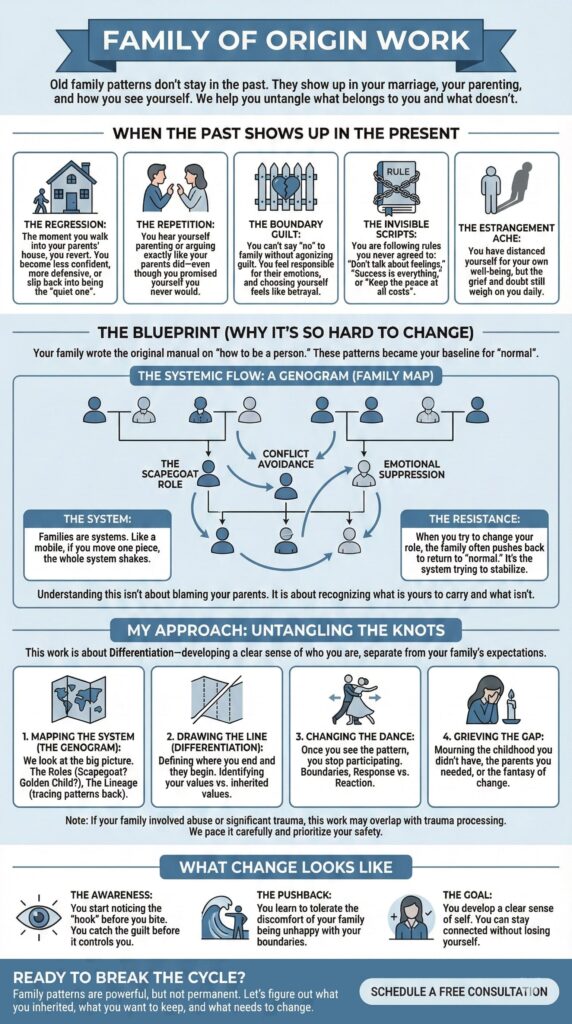
Old family patterns don’t stay in the past.
 Signs
Signs Why
Why Approach
 Outcomes
 Summary
 FAQs
FAQsWhen the Past Shows Up in the Present
- The Regression: The moment you walk into your parents’ house, you revert. You become less confident, more defensive, or slip back into being the “quiet one” or the “helper.”
- The Repetition: You hear yourself parenting or arguing exactly like your parents did—even though you promised yourself you never would.
- The Boundary Guilt: You can’t say “no” to family without agonizing guilt. You feel responsible for their emotions, and choosing yourself feels like a betrayal.
- The Invisible Scripts: You are following rules you never agreed to: “Don’t talk about feelings,” “Success is everything,” or “Keep the peace at all costs.”
- The Estrangement Ache: You have distanced yourself for your own well-being, but the grief and doubt still weigh on you daily.
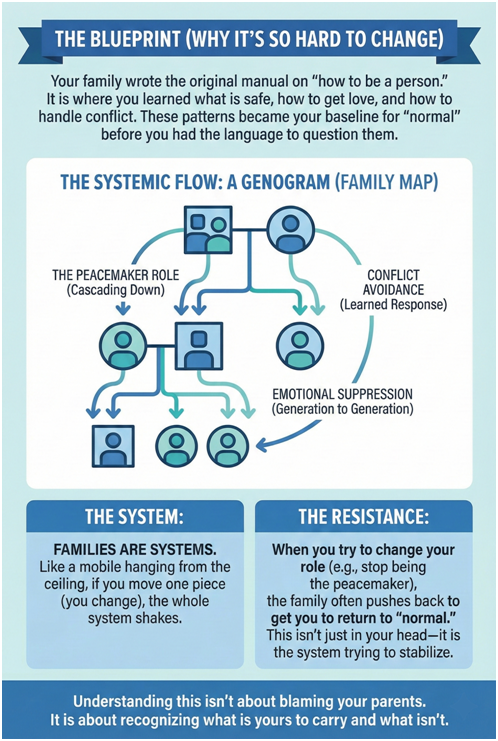
The Blueprint (Why It's So Hard to Change)
- The System: Families are systems. Like a mobile hanging from the ceiling, if you move one piece (you change), the whole system shakes.
- The Resistance: When you try to change your role (e.g., stop being the peacemaker), the family often pushes back to get you to return to “normal.” This isn’t just in your head—it is the system trying to stabilize.

My Approach: Untangling the Knots
- The Roles: Were you the Scapegoat? The Golden Child? The Caretaker?
- The Lineage: We trace the patterns back. Often, realizing that your parent was acting out their own parent’s unhealed wound creates space for compassion without excusing the harm.
- The Work: We identify the difference between your values and the values you inherited. We learn that you are not responsible for managing your parents’ emotions.
- What to Keep: Not everything from your family is unhealthy. We identify what’s worth keeping and what needs to change.
- Boundaries: We learn to say “no” or limit contact without collapsing into shame.
- Response vs. Reaction: We practice pausing when a button is pushed, so you can choose a new response rather than slipping into the old script.

Ready to Untangle the Knots?
Family patterns run deep. Let's make sense of where they came from so they stop running your life.
$150 per 50-minute session - Insurance billing available
What Change Looks Like
Family of origin work is deep, and often slow.

The Awareness
You start noticing the "hook" before you bite. You catch the guilt before it controls your decision.
The Pushback
You learn to tolerate the discomfort of your family being unhappy with your boundaries, knowing that their reaction is not your responsibility.

The Goal
You develop a clear sense of self. You can stay connected to your family (if you choose) without losing yourself in the process.

Page Summary
References
Psychology Today. (n.d.). Family dynamics. Retrieved January 28, 2026, from https://www.psychologytoday.com/us/basics/family-dynamics
Simpson, J. A., & Rholes, W. S. (2017). Adult attachment, stress, and romantic relationships. Current Opinion in Psychology, 13, 19–24. https://doi.org/10.1016/j.copsyc.2016.04.006
Frequently Asked Questions About Family of Origin Work
What is family-of-origin work in counselling, and how does it help?
Family-of-origin work examines the patterns, roles, rules, and attachment styles you developed in your childhood family to understand how they shape your current relationships, emotional responses, and sense of self. The goal isn’t to blame your family but to identify unconscious patterns so you can make conscious choices about which patterns to keep and which to change.
Based on Family Systems Theory, this approach recognizes that we’re shaped by our family’s emotional environment, communication patterns, and relationship dynamics.
What Family-of-Origin Work Examines
Attachment patterns: How your early caregiving experiences shaped your attachment style (secure, anxious, avoidant, disorganized) and how this shows up in adult relationships.
Family roles: Were you the caretaker, scapegoat, golden child, lost child, or mediator? These roles often persist into adulthood.
Communication and conflict patterns: How did your family handle disagreement, express emotions, or deal with difficult topics? You likely replicate or react against these patterns.
Unspoken rules: “Don’t talk about feelings,” “Always look perfect to outsiders,” “Your needs don’t matter,” “Conflict is dangerous.” These implicit rules shape adult behavior.
How It Helps
Understanding your automatic reactions: When you recognize that your intense reaction to your partner being late mirrors abandonment fear from an unreliable parent, you can respond to the current situation rather than the old wound.
Breaking repetitive patterns: You stop unconsciously choosing unavailable partners, people-pleasing to earn love, or sabotaging relationships when intimacy feels threatening.
Grieving what you didn’t receive: Many people carry unacknowledged grief about the parenting they needed but didn’t get. Naming this grief reduces its power over current life.
Choosing consciously: Instead of automatically replicating family patterns or rigidly rebelling against them, you choose values-aligned behaviors.
Case Example (Composite scenario for educational purposes)
A client came to therapy for “work stress” but through family-of-origin exploration, we discovered he was the family mediator growing up, managing his parents’ conflicts and siblings’ emotions. He’d replicated this role at work, taking responsibility for team dynamics and burning out trying to keep everyone happy. Understanding this pattern allowed him to recognize that managing others’ emotions wasn’t his job and set boundaries protecting his capacity.
Learn more about family-of-origin approaches and what to expect, including genogram work and detailed process using Family Systems Theory.
Ready to understand your family patterns?
Book your first session in Victoria, Langford, Saanich, the Westshore, or Sooke.
Related Questions
- Why do I keep choosing partners who feel similar to one of my parents?
- Can family-of-origin work help me stop repeating the same relationship problems?
- How do I explore family-of-origin issues if I feel loyal to my parents and don’t want to ‘blame’ them?
- What does healing from family-of-origin issues realistically look like; will my story always define me?
Service Pages
- Family Systems Theory \- Detailed genogram work, family roles exploration, intergenerational trauma patterns, and comprehensive case studies
- Acceptance and Commitment Therapy (ACT) \- Values clarification and committed action
- Family Systems Theory \- Theoretical foundation
- Relationship Counselling for Individuals \- Improving relationships through individual work
Evidence-Based Practice References
1. Bowen, M. (1978). Family therapy in clinical practice. Jason Aronson. https://books.google.com/books?id=jHhHAAAAMAAJ
2. McGoldrick, M., Gerson, R., & Petry, S. (2008). Genograms: Assessment and intervention (3rd ed.). W. W. Norton & Company. https://psycnet.apa.org/record/2008-01441-000
3. Framo, J.L. (1992). Family-Of-Origin Therapy: An Intergenerational Approach (1st ed.). Routledge. https://doi.org/10.4324/9780203776728
What does healing from family-of-origin issues realistically look like; will my story always define me?
Healing from family-of-origin issues means your childhood patterns no longer unconsciously control your adult choices; you can recognize old wounds when they’re triggered without being overwhelmed by them, and you make decisions based on your values rather than automatic reactions. Your story doesn’t disappear, but it stops being the only story; you become the author of your life rather than remaining a character in your family’s narrative.
Research on post-traumatic growth and narrative therapy shows that healing isn’t about erasing the past; it’s about changing your relationship with it so it informs rather than controls your present.
What Healing Doesn’t Mean
- You won’t forget what happened; memories don’t disappear but lose their emotional grip
- Your family won’t necessarily change; they may never acknowledge what happened or become the family you needed
- You won’t stop having feelings about the past; grief or anger may resurface periodically
- You won’t become perfect; you’ll still have bad days or react from old patterns sometimes
What Healing Does Mean
Patterns lose their automatic quality: You recognize when you’re people-pleasing, avoiding conflict, or choosing unavailable partners. Recognition creates choice; you can pause and choose differently.
Triggers don’t overwhelm you: When something reminds you of childhood wounds, you can identify “This is an old hurt” and respond to the present situation.
You author your own narrative: Instead of being stuck in “I’m the damaged kid from a dysfunctional family,” you integrate that experience: “I grew up in a difficult family AND I’ve developed resilience, empathy, and strength.”
Relationships improve: You choose partners based on compatibility and values rather than unconscious repetition. You can have conflict without it feeling life-threatening.
The Timeline of Healing
Early therapy (months 1-6): Recognition and awareness; identifying patterns and connecting them to family-of-origin.
Middle phase (months 6-18): Active change; practicing new behaviors, processing grief and anger, experiencing setbacks and progress.
Later phase (months 18+): Integration; new patterns feel more natural, old patterns happen less frequently, can catch yourself quickly.
Ongoing: Healing is lifelong. Old patterns may resurface during stress or transitions. You return to therapy as needed for tune-ups.
Case Example (Composite scenario for educational purposes)
A client began therapy convinced she was “broken” because of childhood emotional neglect. She believed her anxious attachment would always define her. Through family-of-origin work, she processed grief, developed skills to recognize when anxiety was old fear vs. current situation, and built secure relationships. Two years later, she said “I still have moments where that scared kid shows up, but now I can recognize her, comfort her, and still show up in my relationship from my adult self. My past shaped me, but it doesn’t run my life anymore.”
Your history matters, but it doesn’t have the final word.
Learn more about what realistic healing looks like using Family Systems Theory approach.
Ready to rewrite your story?
Book your first session in Victoria, Langford, Saanich, the Westshore, or Sooke.
Related Questions
- What is family-of-origin work in counselling, and how does it help?
- Can family-of-origin work help me stop repeating the same relationship problems?
- How do I grieve the childhood or family I wish I’d had but never did?
- What if my family denies there was any problem; can I still heal without their validation?
Service Pages
- Family Systems Theory \- Detailed healing timeline, post-traumatic growth, narrative therapy approaches, and extended case studies
- Acceptance and Commitment Therapy (ACT) \- Values-aligned living and psychological flexibility
- Trauma & PTSD Therapy \- Processing childhood trauma
- Narrative Therapy \- Authoring new narratives
Evidence-Based Practice References
1. Shenxin, S. (2025). Rewriting the Trauma Narrative: A Case Study on the Effects of Narrative Therapy for a College Student with a History of Childhood Domestic Violence. \
2. Tedeschi, R. G., & Calhoun, L. G. (2004). Posttraumatic growth: Conceptual foundations and empirical evidence. Psychological Inquiry, 15(1), 1–18. https://doi.org/10.1207/s15327965pli1501\_01
3. Siegel, D. J. (2012). The developing mind: How relationships and the brain interact to shape who we are (2nd ed.). The Guilford Press. https://psycnet.apa.org/record/2012-12726-000
Why do I keep choosing partners who feel similar to one of my parents?
You unconsciously seek familiar relationship patterns, even painful ones, because your brain interprets “familiar” as “safe” and attempts to resolve unfinished emotional business from childhood through adult relationships. This pattern, called “repetition compulsion,” isn’t about conscious choice or poor judgment; it’s your attachment system trying to get different outcomes from familiar dynamics.
Research on attachment and mate selection shows that people consistently choose partners whose emotional patterns mirror their early caregiving experiences, particularly the parent with whom they had the most conflicted relationship.
Why Familiar Feels Like Home (Even When It Hurts)
Your earliest relationships create neural pathways for what “love” feels like. If your father was emotionally unavailable, partners who are distant may feel more like “real love” than someone actually available. You’re not trying to recreate pain; you’re unconsciously trying to master it, believing “This time, if I’m good enough, they’ll finally give me what I needed from my parent.”
Common Parent-Partner Parallels
Emotionally unavailable parent → Unavailable partners: You learned love requires pursuing someone who withdraws. Available partners feel boring because you’ve confused anxiety with attraction.
Critical parent → Critical partners: You’re drawn to people whose approval feels hard-won because that’s the only approval that feels “real.”
Controlling parent → Controlling partners: You mistake control for care. Healthy autonomy feels like abandonment.
Case Example (Composite scenario for educational purposes)
A client kept dating charming but emotionally unavailable men. Her father was charismatic during brief post-divorce visits but unreliable when she needed support. She’d learned “love” meant working hard to maintain someone’s interest. The pattern broke when she recognized her father’s unavailability wasn’t about her worth, grieved the reliable father she needed, and learned anxiety about whether someone cares isn’t the same as attraction.
Learn more about attachment patterns and relationship choices using Family Systems Theory therapeutic approach.
Ready to understand your relationship patterns?
Book your first session in Victoria, Langford, Saanich, the Westshore, or Sooke to explore family-of-origin influences on your relationships.
Related Questions
- Can family-of-origin work help me stop repeating the same relationship problems?
- What is family-of-origin work in counselling, and how does it help?
- How do I explore family-of-origin issues if I feel loyal to my parents and don’t want to ‘blame’ them?
- What does healing from family-of-origin issues realistically look like; will my story always define me?
Service Pages
- Family Systems Theory \- Comprehensive attachment patterns, detailed parent-partner parallels, repetition compulsion mechanisms, and extended case studies
- Relationship Counselling for Individuals \- Working on relationship patterns outside couple therapy
- Acceptance and Commitment Therapy (ACT) \- Values-aligned relationship choices
Evidence-Based Practice References
1. Hazan, C., & Shaver, P. (1987). Romantic love conceptualized as an attachment process. Journal of Personality and Social Psychology, 52(3), 511–524. https://doi.org/10.1037/0022-3514.52.3.511
2. Mikulincer, M., & Shaver, P. R. (2020). Attachment theory. In P. J. Corr & G. Matthews (Eds.), The Cambridge handbook of personality psychology (2nd ed., pp. 208–219). Cambridge University Press. https://doi.org/10.1017/9781108264822.020
Can family-of-origin work help me stop repeating the same relationship problems?
Yes. Family-of-origin work helps you identify the relationship patterns you learned in childhood that you’re unconsciously repeating as an adult, so you can interrupt automatic reactions and make conscious, values-aligned choices instead. Most relationship problems aren’t about your current partner; they’re about patterns formed in your first relationships that you’re projecting onto adult relationships.
Research shows that unresolved family-of-origin issues are among the strongest predictors of relationship distress in adulthood.
Common Relationship Patterns Rooted in Family
People-pleasing and losing yourself: If you learned your needs were less important than keeping peace or managing a parent’s emotions, you automatically sacrifice yourself in relationships, then resent your partner.
Conflict avoidance or explosion: If your family handled conflict through silent treatment, explosive anger, or pretending nothing happened, you bring these strategies to adult relationships.
Pursuing or distancing: If a parent was inconsistently available, you anxiously pursue partners for reassurance. If a parent was intrusive, you create distance to feel safe.
Expecting rejection: If you learned you were “too much” or “not enough,” you interpret normal conflicts as evidence your partner will leave.
How the Patterns Repeat Without Awareness
Projection: You unconsciously assign your parent’s qualities to your partner. If your father was critical, you may hear criticism in neutral comments because your nervous system is primed for it.
Reactivity: Your partner does something that mirrors a childhood pattern and you react with the intensity of old wounds, not the current situation.
Role assignment: You unconsciously cast your partner in the role of the parent you’re trying to heal from, then get upset when they behave according to the script.
Case Example (Composite scenario for educational purposes)
A client reported every relationship ended the same way: she’d feel close initially, then her partner would need space or time with friends, she’d panic about abandonment, become demanding, and the relationship would implode. Her mother had undiagnosed depression and periodically withdrew emotionally, leaving her terrified. She was recreating this panic whenever a partner needed normal autonomy, interpreting healthy space as abandonment. Recognizing this pattern allowed her to distinguish between her partner’s need for space and her childhood terror.
Learn more about family patterns and relationship cycles using Family Systems Theory approach.
Ready to break relationship patterns?
Book your first session in Victoria, Langford, Saanich, the Westshore, or Sooke.
Related Questions
- Why do I keep choosing partners who feel similar to one of my parents?
- What is family-of-origin work in counselling, and how does it help?
- Can family-of-origin work help me stop people-pleasing and start setting healthy boundaries?
- What does healing from family-of-origin issues realistically look like; will my story always define me?
Service Pages
- Family Systems Theory \- Detailed projection, reactivity, and role assignment patterns; extended relationship cycle examples
- Relationship Counselling for Individuals \- Working on relationship patterns outside couple therapy
- Acceptance and Commitment Therapy (ACT) \- Values-aligned relationship choices
Evidence-Based Practice References
1. Mikulincer, M., Shaver, P.R. & Pereg, D. Attachment Theory and Affect Regulation: The Dynamics, Development, and Cognitive Consequences of Attachment-Related Strategies. Motivation and Emotion 27, 77–102 (2003). https://doi.org/10.1023/A:1024515519160 2. Titelman, P. (Ed.). (2014). Differentiation of Self: Bowen Family Systems Theory Perspectives (1st ed.). Routledge. https://doi.org/10.4324/9780203121627
What is codependency, and how is it connected to my family-of-origin?
Codependency is a pattern where you prioritize others’ needs, feelings, and approval over your own to the point where you lose sense of yourself and derive your worth from taking care of others or managing their problems. This pattern typically develops in families where children learned that their role was to manage a parent’s emotions, keep peace, or take care of adult responsibilities, teaching them that their value comes from serving others.
Research shows that codependency most commonly develops in families with addiction, mental illness, chronic conflict, or emotional neglect.
How Codependency Develops in Childhood
Parentification: You became the emotional caretaker for your parent, managing their moods, providing comfort they should have received from adults, or taking care of siblings. You learned that love means sacrificing your needs.
Conditional worth: Your parent’s love or attention was conditional on your behavior or achievements. You learned that you’re only valuable when useful to others.
Enmeshment: Emotional boundaries were blurred. You were expected to feel what your parent felt, fix their problems, or be responsible for their happiness.
The Difference Between Caring and Codependency
Healthy caring: You help others from choice and genuine desire, while maintaining boundaries and recognizing you’re not responsible for their feelings. You can care for others AND yourself.
Codependency: You help compulsively, even when it harms you, because your worth depends on being needed. You can’t say no without intense guilt. Others’ problems feel like your responsibility. Your identity is consumed by caretaking.
Case Example (Composite scenario for educational purposes)
A client described chronic exhaustion from managing everyone’s problems; her sister’s drama, her mother’s loneliness, her partner’s career stress. She couldn’t say no without intense guilt. Her alcoholic father’s moods dominated the household. She learned to monitor his emotional state, prevent conflict, and care for younger siblings. Her worth became tied to keeping everyone stable. She was replicating this pattern in adult relationships. Healing involved recognizing that caretaking was a survival strategy in childhood but now prevented genuine connection, and learning that her worth exists independently of usefulness.
Learn more about codependency and family-of-origin connections using Family Systems Theory approach.
Ready to address codependent patterns?
Book your first session in Victoria, Langford, Saanich, the Westshore, or Sooke.
Related Questions
- Why do I feel guilty or selfish any time I say no or set boundaries, just like in my family growing up?
- Can family-of-origin work help me stop people-pleasing and start setting healthy boundaries?
- What is family-of-origin work in counselling, and how does it help?
- Can family-of-origin work help me heal from childhood emotional neglect?
Service Pages
- Family Systems Theory \- Detailed parentification patterns, enmeshment dynamics, and codependency recovery strategies
- Acceptance and Commitment Therapy (ACT) \- Values clarification and self-compassion
- Relationship Counselling for Individuals \- Boundary-setting and communication skills
Evidence-Based Practice References
1. Wells, M., Glickauf-Hughes, C., & Jones, R. (1999). Codependency: A grass roots construct’s relationship to shame-proneness, low self-esteem, and childhood parentification. American Journal of Family Therapy, 27(1), 63–71. https://doi.org/10.1080/019261899262104
2. Hooper, L. M. (2007). The application of attachment theory and family systems theory to the phenomena of parentification. The Family Journal, 15(3), 217–223. https://doi.org/10.1177/1066480707301290
How do I explore family-of-origin issues if I feel loyal to my parents and don't want to 'blame' them?
Family-of-origin work isn’t about blaming your parents; it’s about understanding the patterns you learned in your family so you can make conscious choices about which patterns to keep and which to change. You can acknowledge that your parents did the best they could with what they knew, AND recognize that what you experienced wasn’t what you needed; both things can be true.
Research in family therapy emphasizes differentiation; the ability to maintain emotional connection with family while developing your own separate identity and beliefs.
The False Choice
Many people believe they have to choose between loyalty to their family and their own wellbeing. But loyalty that requires silence about your experience isn’t true connection; it’s compliance. You may feel that examining family patterns is betrayal, especially if your parents sacrificed for you or if their struggles were due to circumstances beyond their control (poverty, immigration, illness).
What Family-of-Origin Work Actually Examines
Patterns, not people: We look at relationship patterns (how conflict was handled, how emotions were expressed) rather than labeling parents as “good” or “bad.” Your parents learned these patterns from their families; you’re breaking a generational cycle, not condemning individuals.
Impact vs. intention: Your parents may have had good intentions and still caused harm through patterns they unconsciously repeated. Acknowledging impact doesn’t deny their love or effort.
What you needed vs. what was possible: Sometimes parents couldn’t provide what you needed due to their own trauma, mental health, or resources. Recognizing “I needed X and didn’t receive it” is different from “My parents were terrible people.”
The Difference Between Blaming and Understanding
Blaming (not the goal): Focuses on condemning parents, keeps you stuck in victim role, prevents taking responsibility for current choices.
Understanding (the actual goal): Identifies patterns that shaped you, empowers you to make different choices, allows grief for what wasn’t possible, creates space for both appreciation AND acknowledgment of harm.
Case Example (Composite scenario for educational purposes)
A client felt intense guilt about “complaining” that her mother was critical and controlling, saying “She immigrated with nothing and sacrificed everything for us.” Through therapy, she learned to hold both truths: her mother’s immense sacrifice and strength, AND the fact that constant criticism hurt her. She didn’t need to deny her mother’s love to acknowledge the pattern’s impact. This actually improved their relationship; she could set boundaries without resentment.
Common reframe: “My parents did the best they could, AND what I experienced wasn’t what I needed. I can honor their efforts while choosing different patterns for myself.”
Learn more about navigating loyalty and family-of-origin work without blame using Family Systems Theory approach.
Ready to explore family patterns without blame?
Book your first session in Victoria, Langford, Saanich, the Westshore, or Sooke.
Related Questions
- What if my family denies there was any problem; can I still heal without their validation?
- What is family-of-origin work in counselling, and how does it help?
- How do I grieve the childhood or family I wish I’d had but never did?
- What does healing from family-of-origin issues realistically look like; will my story always define me?
Service Pages
- Family Systems Theory \- Detailed differentiation work, impact vs. intention framework, and cultural/immigration context considerations
- Acceptance and Commitment Therapy (ACT) \- Values clarification while honoring family
- Relationship Counselling for Individuals \- Improving family relationships through individual work
Evidence-Based Practice References
Skowron, E. A., & Schmitt, T. A. (2003). Assessing interpersonal fusion: Reliability and validity of a new DSI fusion with others subscale. Journal of Marital and Family Therapy, 29(2), 209–222. https://doi.org/10.1111/j.1752-0606.2003.tb01201.x
Kimmes, J. G., Edwards, A. B., Wetchler, J. L., & Bercik, J. (2014). Self and Other Ratings of Dyadic Empathy as Predictors of Relationship Satisfaction. The American Journal of Family Therapy, 42(5), 426–437. https://doi.org/10.1080/01926187.2014.925374
What if my family denies there was any problem; can I still heal without their validation?
Yes. You can heal from family-of-origin wounds without your family acknowledging what happened, because healing depends on your own processing and meaning-making, not on others’ agreement with your reality. In fact, waiting for family validation often keeps you stuck, because people who caused harm (even unintentionally) rarely have the capacity to fully acknowledge it.
Research on trauma recovery shows that external validation can support healing, but it’s not necessary. Internal validation, therapeutic witnessing, and finding your own truth are sufficient for recovery.
Why Families Deny
Protective mechanisms: Denial protects your family from shame, guilt, or having to confront their own childhood wounds. If your parent acknowledges they hurt you, they may have to face that their parent hurt them.
Different realities: Your sibling may genuinely remember your childhood differently. Birth order, gender, timing, and your parent’s mental health at different stages mean each family member had a different experience.
Invested in a narrative: Families often have a collective story (“We’re a close family,” “We overcame everything together”) that requires denying problems. Your truth threatens the narrative they need to maintain.
The Trap of Seeking Validation
If you need your family to admit what happened before you can heal, you’ve given them power over your recovery. They may never be capable of that acknowledgment. You may search for the perfect evidence or explanation that will finally make them understand, keeping you focused on convincing them rather than healing yourself.
You need to grieve not only what happened, but also the fact that they’ll never acknowledge it. This is an additional loss.
How You Heal Without Their Agreement
Trust your own experience: If you remember feeling alone, scared, or unseen, that was your reality. You don’t need anyone else to confirm it. Your feelings and memories are valid evidence.
Therapeutic witnessing: A therapist who believes you and understands the dynamics can provide the validation your family can’t or won’t give.
Build new narratives: You get to author your own story rather than being confined to your family’s version.
Case Example (Composite scenario for educational purposes)
A client described emotional neglect; parents who were physically present but emotionally absent, dismissive, and critical. When she tried discussing this as an adult, her parents said “You had everything you needed; you’re being dramatic.” Her siblings said “I don’t remember it that way.” Through therapy, she learned that emotional neglect is often invisible to those not experiencing it, that her siblings’ different experience didn’t negate hers, and that her parents’ denial was about their limitations, not the truth of her experience. She stopped seeking their validation and focused on her own healing.
Learn more about healing when family denies your experience using Family Systems Theory approach.
Ready to heal on your own terms?
Book your first session in Victoria, Langford, Saanich, the Westshore, or Sooke.
Related Questions
- How do I explore family-of-origin issues if I feel loyal to my parents and don’t want to ‘blame’ them?
- Can family-of-origin work help me heal from childhood emotional neglect?
- How do I grieve the childhood or family I wish I’d had but never did?
- What does healing from family-of-origin issues realistically look like; will my story always define me?
Service Pages
- Family Systems Theory \- Detailed gaslighting vs. genuine memory difference, narrative therapy approaches, and building self-trust
- Acceptance and Commitment Therapy (ACT) \- Values-based living independent of family validation
- Trauma & PTSD Therapy \- Processing trauma without family acknowledgment
- Narrative Therapy \- Authoring your own story
Evidence-Based Practice References
1. Zupanick, C. E. (1994). Adult children of dysfunctional families: Treatment from a disenfranchised grief perspective. Death Studies, 18(2), 183–195. https://doi.org/10.1080/07481189408252650
2. Defrain, J., Jones, J. E., Skogrand, L., & Defrain, N. (2003). Surviving and Transcending a Traumatic Childhood: An Exploratory Study. Marriage & Family Review, 35(1–2), 117–146. https://doi.org/10.1300/J002v35n01\_08
How do I grieve the childhood or family I wish I'd had but never did?
You grieve what you didn’t have by naming the specific losses (the emotional safety, consistent love, or validation you needed), allowing yourself to feel the sadness and anger about what should have been different, and eventually accepting what was while building what you need now. This grief is often called “ambiguous loss”; you’re mourning something that never existed rather than something you had and lost.
Research on grief shows that losses that aren’t socially recognized (like the loss of a childhood you never had) are often more difficult to process because they lack clear rituals or validation from others.
Why This Grief Is Uniquely Difficult
Invisible loss: Others can see when someone loses a parent to death, but they can’t see when you lost the emotionally available parent you needed. People may say “But your parents are still alive” or “At least you had food and shelter,” invalidating the emotional loss.
Ambiguous: You’re grieving something that never was. There’s no funeral, no clear “before and after.”
Loyalty and guilt: Grieving what you didn’t receive can feel like betrayal, especially if your parents sacrificed materially or “did their best.”
What You Might Be Grieving
- The parent who saw and valued you for who you were, not the version they wanted
- Emotional safety and security; a home where you felt safe to express feelings or make mistakes
- Consistent, reliable love; knowing your parent would show up emotionally
- Childhood appropriate to your age; being allowed to be a child rather than a caretaker
Processing the Grief
Denial: “It wasn’t that bad,” “Other people had it worse.” This protects you from the full weight of loss but keeps you stuck.
Anger: When denial breaks, rage often surfaces. “Why didn’t they protect me?” This anger is necessary and healthy.
Sadness: Deep grief about what should have been different. This often includes crying for the child you were who deserved better.
Acceptance: Not forgiveness necessarily, but acceptance of what was and wasn’t possible. Your parent had limitations, and those limitations hurt you. Both things are true.
Case Example (Composite scenario for educational purposes)
A client felt empty and angry but couldn’t explain why; she had “a normal childhood.” Through therapy, we identified profound emotional neglect. Her parents provided materially but were emotionally unavailable and dismissive. She’d never acknowledged her grief because she believed “they did their best.” Naming her grief—for the parent who would have comforted her when scared, celebrated her joy, or sat with her in sadness—allowed her to finally mourn the childhood she needed. Accepting what wasn’t possible freed her to build the emotional connections she needed in adult relationships.
Learn more about grieving childhood losses and building what you need now using Family Systems Theory approach.
Ready to grieve what you didn’t have?
Book your first session in Victoria, Langford, Saanich, the Westshore, or Sooke.
Related Questions
- Can family-of-origin work help me heal from childhood emotional neglect?
- What if my family denies there was any problem; can I still heal without their validation?
- How do I explore family-of-origin issues if I feel loyal to my parents and don’t want to ‘blame’ them?
- What does healing from family-of-origin issues realistically look like; will my story always define me?
Service Pages
- Family Systems Theory \- Detailed ambiguous loss work, stages of grieving what you didn’t have, and building emotional security
- Acceptance and Commitment Therapy (ACT) \- Self-compassion and values-aligned living
- Trauma & PTSD Therapy \- Processing childhood trauma
- About Sean Lewis, MA, MDiv, CCC \- Complete credentials and therapeutic approach
Evidence-Based Practice References
1. Boss, P. (1999). Ambiguous loss: Learning to live with unresolved grief. Harvard University Press.
2. Gibson, L. C. (2015). Adult children of emotionally immature parents: How to heal from distant, rejecting, or self-involved parents. New Harbinger Publications.
Why do I feel guilty or selfish any time I say no or set boundaries, just like in my family growing up?
You feel guilty setting boundaries because your family taught you (explicitly or implicitly) that your needs are less important than others’, that saying no makes you a bad person, or that love requires sacrificing yourself. This pattern persists into adulthood because guilt was used as a control mechanism; expressing needs or setting limits triggered withdrawal, anger, or “you’re being selfish” messages that conditioned you to associate boundaries with badness.
Research on family dynamics shows that children who grow up in enmeshed families or with parents who have poor boundaries often develop intense guilt about normal self-care and autonomy.
How Families Teach Boundary Guilt
Explicit messaging: “You’re so selfish,” “After all I’ve done for you,” “If you really loved me, you’d…” These messages directly equate boundaries with moral failure.
Withdrawal and punishment: When you said no as a child, your parent withdrew love or gave silent treatment. You learned that boundaries risk abandonment.
Guilt as manipulation: Your parent used guilt to control behavior. “You’re breaking my heart,” “I guess I’ll just suffer alone.” You learned your boundaries hurt others.
How This Shows Up in Adult Life
- Automatic “yes” even when you want to say no; the words feel physically impossible
- Over-explaining and justifying; can’t just say “I’m not available” without extensive reasons
- Resentment building; you say yes but feel angry, and it leaks out as passive aggression
- Feeling selfish for basic self-care; taking time for yourself feels indulgent and wrong
The Difference Between Healthy Guilt and Conditioned Guilt
Healthy guilt: You’ve actually violated your values or harmed someone. It signals misalignment between actions and values. This guilt is useful; it motivates repair.
Conditioned (neurotic) guilt: You feel guilty for having needs, taking up space, disappointing people, or saying no—none of which are actual moral failures. This guilt was conditioned through family dynamics.
Test: If you feel guilty for basic self-care (eating, sleeping, declining optional requests), that’s conditioned guilt.
Case Example (Composite scenario for educational purposes)
A client couldn’t say no to anyone without overwhelming guilt, then burned out trying to meet everyone’s needs. Her mother had undiagnosed depression and would withdraw or cry when the client had her own plans or friends. She learned that her autonomy caused her mother pain, so having separate needs felt cruel. She replicated this with friends, partners, and colleagues. Healing involved recognizing that her mother’s inability to tolerate separation was her mother’s limitation, not evidence that boundaries are selfish, and learning that healthy relationships survive boundaries.
Key principle: You can feel guilty AND still set the boundary. The guilt doesn’t mean the boundary is wrong; it means you’re breaking old family rules.
Learn more about boundaries and family-of-origin guilt using Family Systems Theory approach.
Ready to set boundaries without guilt?
Book your first session in Victoria, Langford, Saanich, the Westshore, or Sooke.
Related Questions
- What is codependency, and how is it connected to my family-of-origin?
- Can family-of-origin work help me stop people-pleasing and start setting healthy boundaries?
- How do I explore family-of-origin issues if I feel loyal to my parents and don’t want to ‘blame’ them?
- What is family-of-origin work in counselling, and how does it help?
Service Pages
- Family Systems Theory \- Detailed enmeshment patterns, guilt as control mechanism, and boundary-setting skills
- Acceptance and Commitment Therapy (ACT) \- Values-aligned action despite guilt
- Relationship Counselling for Individuals \- Boundary-setting and communication skills
Evidence-Based Practice References
1. Golan, Y., & Goldner, L. (2019). The contributions of boundary dissolution and trust in the romantic partner to young mothers’ parenting representations. Early Child Development and Care, 189(3), 463–475. https://doi.org/10.1080/03004430.2017.1326107
2. Forward, S., & Frazier, D. (1997). Emotional blackmail: When the people in your life use fear, obligation, and guilt to manipulate you. HarperCollins.
3. M. Rostami and S. Navabinejad, “The Impact of Unresolved Family-of-Origin Trauma on Marital Vulnerability: A Narrative Analysis”, \[Online\]. Available: https://www.jrpct.com/index.php/rpct/article/view/8
Can family-of-origin work help me stop people-pleasing and start setting healthy boundaries?
Yes. Family-of-origin work helps you understand why people-pleasing feels necessary (usually because boundaries weren’t safe in your family) and builds skills to set boundaries aligned with your values rather than fear. People-pleasing isn’t a personality trait; it’s a survival strategy you learned when expressing needs or saying no resulted in punishment, withdrawal, or guilt.
Research shows that people-pleasing behaviors typically develop in families where children’s worth was conditional, where they had to manage a parent’s emotions, or where conflict and autonomy were dangerous.
Why People-Pleasing Developed
Your needs weren’t safe to express: When you expressed needs as a child, you were told you were “too much,” “demanding,” or “selfish,” or your parent withdrew emotionally. You learned to hide needs to stay safe.
Love was conditional: Your parent’s affection depended on you being “good,” compliant, or helpful. You learned that your authentic self wasn’t lovable; only your pleasing self was acceptable.
You were responsible for your parent’s emotions: If your parent was happy, you’d done well. If upset, it was your fault. You learned to monitor and manage others’ emotional states constantly.
How People-Pleasing Shows Up Now
- Automatic “yes”; you agree before considering whether you want to or can realistically do something
- Difficulty knowing what you want; you’re so focused on what others want that you’ve lost access to your own preferences
- Resentment and exhaustion; chronically overcommitted but can’t stop saying yes
- Fear of disappointing anyone; the thought of someone being upset with you feels unbearable
The Connection to Family Patterns
If saying no to your parent meant withdrawal or rage, saying no to anyone now triggers that same fear, even if the current person is safe. You’re unconsciously trying to earn from friends, partners, or bosses the consistent approval your parent never gave. Part of you believes that if you stop pleasing people, they’ll leave.
Case Example (Composite scenario for educational purposes)
A client couldn’t say no to colleagues, friends, or family without intense anxiety. Her father’s love was conditional on her being helpful and achieving. When she expressed needs or said no, he would withdraw or say “I guess you don’t care about this family.” She learned her worth depended on usefulness and that boundaries meant abandonment. Healing involved recognizing that people-pleasing protected her as a child but now prevented genuine connection, and learning that healthy relationships can tolerate boundaries.
Important: Setting boundaries doesn’t mean becoming selfish. It means caring for yourself with the same energy you give others, which creates sustainable relationships.
Learn more about people-pleasing, boundaries, and family-of-origin patterns using Family Systems Theory approach.
Ready to stop people-pleasing?
Book your first session in Victoria, Langford, Saanich, the Westshore, or Sooke.
Related Questions
- Why do I feel guilty or selfish any time I say no or set boundaries, just like in my family growing up?
- What is codependency, and how is it connected to my family-of-origin?
- Can family-of-origin work help me stop repeating the same relationship problems?
- What does healing from family-of-origin issues realistically look like; will my story always define me?
Service Pages
- Family Systems Theory \- Detailed people-pleasing origins, boundary-setting practice, and conditional love patterns
- Acceptance and Commitment Therapy (ACT) \- Values clarification and willingness
- Relationship Counselling for Individuals \- Boundary-setting and communication skills
Evidence-Based Practice References
1. M. Rostami and S. Navabinejad, “The Impact of Unresolved Family-of-Origin Trauma on Marital Vulnerability: A Narrative Analysis”, \[Online\]. Available: https://www.jrpct.com/index.php/rpct/article/view/8 2. 3. Y. Golan and L. Goldner, “The contributions of boundary dissolution and trust in the romantic partner to young mothers’ parenting representations,” Early Child Development and Care, vol. 189, no. 3, pp. 463–475, Feb. 2019, https://cris.haifa.ac.il/en/publications/the-contributions-of-boundary-dissolution-and-trust-in-the-romant/
Can family-of-origin work help me heal from childhood emotional neglect?
Yes. Family-of-origin work is particularly effective for childhood emotional neglect because this type of trauma is often invisible and invalidated, making it difficult to recognize and name without therapeutic support. Emotional neglect (parents who were physically present but emotionally unavailable, dismissive, or unable to attune to your feelings) creates attachment wounds, difficulty identifying emotions, and a sense that your inner world doesn’t matter.
Research shows that childhood emotional neglect is strongly associated with adult depression, anxiety, relationship difficulties, and low self-worth.
Why Emotional Neglect Is Particularly Difficult
Invisible trauma: There are no physical scars or dramatic events. It’s defined by absence: absence of emotional attunement, validation, comfort, or interest in your inner world.
Invalidating: Others often say “But your parents loved you,” “You had food and shelter,” or “It could have been worse,” making you doubt whether your pain is legitimate.
Self-blame: Without understanding emotional neglect, you may conclude you’re “too sensitive,” “broken,” or “can’t connect” rather than recognizing your emotional needs weren’t met.
Common Effects of Childhood Emotional Neglect
- Difficulty identifying your emotions (alexithymia); you might feel “off” but can’t name if it’s sadness, anger, fear, or loneliness
- Feeling empty or numb; going through motions without feeling fully alive
- Belief that your feelings don’t matter; you minimize emotions or feel guilty for having needs
- Difficulty in relationships; struggle to express feelings, ask for what you need, or trust others care
- Chronic sense of being “too much” or “not enough”
How Family-of-Origin Work Addresses Emotional Neglect
Naming the neglect: Many people lack language for what they experienced. Therapy provides concepts like “emotional neglect,” “dismissive attachment,” or “emotional unavailability” that validate your experience.
Grieving what you didn’t receive: You need to mourn the emotional attunement, validation, and comfort you should have received.
Developing emotional awareness: Through therapy, you learn to identify, name, and validate your own emotions—skills your parents should have taught you.
Reparenting yourself: You learn to provide yourself the emotional support your parents couldn’t: noticing your feelings, validating them, offering comfort.
Case Example (Composite scenario for educational purposes)
A client couldn’t understand why she felt “hollow” despite a successful career. She described her childhood as “fine; I had everything I needed.” Through family-of-origin exploration, we identified profound emotional neglect. Her parents were immigrants focused on survival. They provided materially but never asked about her feelings, comforted her when upset, or showed interest in her inner world. She learned emotions were irrelevant. As an adult, she couldn’t identify her feelings, felt disconnected in relationships, and believed something was fundamentally wrong with her. Naming the emotional neglect, grieving the attunement she’d needed, and learning to notice and validate her own emotions gradually filled the hollowness.
Important: Emotional neglect is real trauma even when nothing overtly “happened.” What you didn’t receive matters as much as what you did receive.
Learn more about healing from childhood emotional neglect using Family Systems Theory approach.
Ready to heal from emotional neglect?
Book your first session in Victoria, Langford, Saanich, the Westshore, or Sooke.
Related Questions
- How do I grieve the childhood or family I wish I’d had but never did?
- What if my family denies there was any problem; can I still heal without their validation?
- What is family-of-origin work in counselling, and how does it help?
- What does healing from family-of-origin issues realistically look like; will my story always define me?
Service Pages
- Family Systems Theory \- Detailed emotional neglect patterns, alexithymia work, reparenting strategies, and extended case studies
- Acceptance and Commitment Therapy (ACT) \- Self-compassion and emotional awareness
- Depression & Mood \- Addressing depression connected to emotional neglect
- Anxiety Treatment \- Managing anxiety related to unmet childhood needs
Evidence-Based Practice References
1. Shenxin, S. (2025). Rewriting the Trauma Narrative: A Case Study on the Effects of Narrative Therapy for a College Student with a History of Childhood Domestic Violence. \
2. Tedeschi, R. G., & Calhoun, L. G. (2004). Posttraumatic growth: Conceptual foundations and empirical evidence. Psychological Inquiry, 15(1), 1–18. https://doi.org/10.1207/s15327965pli1501\_01
3. Siegel, D. J. (2012). The developing mind: How relationships and the brain interact to shape who we are (2nd ed.). The Guilford Press. https://psycnet.apa.org/record/2012-12726-000
Family of Origin Therapy; Understanding Where Your Patterns Began
Why am I like my parents when I swore I would not be? Why do I feel guilty setting boundaries with family? Why do I people-please even when it costs me everything? If these questions sound familiar, you may be recognizing for the first time that your childhood shaped you in ways you did not choose.
Sean Lewis has watched generational patterns repeat across faith communities, military households, and street-involved populations during a decade of pastoral ministry. He has seen how family roles—the caretaker, the scapegoat, the invisible one—shape adult identity in ways people carry for decades without naming. Bowen family systems research shows these intergenerational patterns transmit reliably across three or more generations until someone intervenes.
Sean works with family of origin material through family systems theory and narrative therapy, helping you externalize the roles you inherited and build boundaries that are not selfish but necessary. He also addresses childhood trauma you did not realize was trauma, emotional neglect, and the weight of still loving a family that hurt you.
Sean offers family of origin therapy in Victoria, BC, from his Colwood office, with generational trauma counselling available virtually across British Columbia. Sessions are covered by most extended health plans through the CCPA. Book a session.