
Narrative Therapy

What is Narrative Therapy?
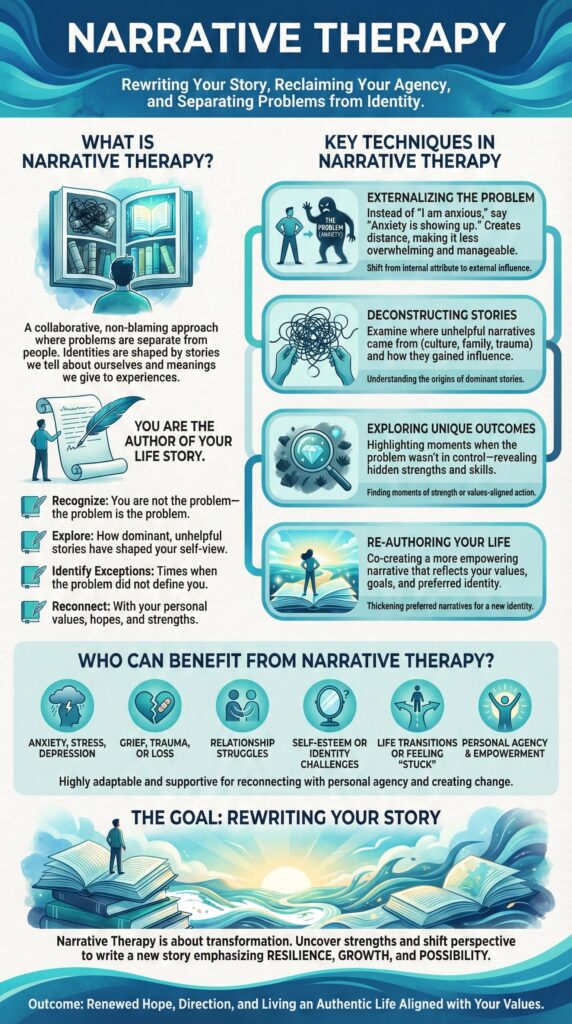
- Recognize that you are not the problem—the problem is the problem.
- Explore how dominant, unhelpful stories have shaped your self-view.
- Identify exceptions—times when the problem did not define you.
- Reconnect with your personal values, hopes, and strengths.

Key Techniques in Narrative Therapy
- Externalizing the Problem: Instead of saying “I am anxious,” you might say “Anxiety is showing up in my life.” This creates distance, making the problem feel less overwhelming and more manageable.
- Deconstructing Stories: Together, you’ll examine where unhelpful narratives came from and how they gained influence over your life.
- Exploring Unique Outcomes: Highlighting moments when the problem wasn’t in control—revealing hidden strengths and skills that can guide your new story.
- Re-authoring Your Life: Co-creating a more empowering narrative that reflects your values, goals, and preferred identity.

Who Can Benefit from Narrative Therapy?
- Anxiety, stress, or depression
- Grief, trauma, or loss
- Relationship struggles
- Self-esteem or identity challenges
- Life transitions or feelings of being “stuck”

The Goal: Rewriting Your Story
Summary
Narrative Therapy; You Are Not Your Diagnosis
If you feel defined by what happened to you, or you want to rewrite your story rather than being stuck in it, narrative therapy offers a way to separate who you are from the problem you are carrying. Developed by Michael White and David Epston, narrative therapy is supported by clinical research as effective for trauma, grief, depression, and identity-related distress.
Sean Lewis has lived a life of continuous re-authoring; from military service to trades ownership to pastoral ministry to counselling. His years at the Mustard Seed Street Church in Victoria were built on honouring every person’s story with dignity, regardless of how society had written them off.
Narrative therapy techniques include externalization, which helps you see the problem as separate from your identity, and re-authoring, which builds a story rooted in your strengths and values rather than your worst chapter. Sean uses narrative therapy across his practice, particularly for trauma, grief, family of origin work, and relational patterns.
Sean offers narrative therapy in Victoria, BC, from his Colwood practice, with virtual sessions across British Columbia. Sessions are covered by most extended health plans through the CCPA. Book a session.