Relationships & Connection
 Signs
Signs Why
Why Approach
 Outcomes
 Summary
 FAQs
FAQs
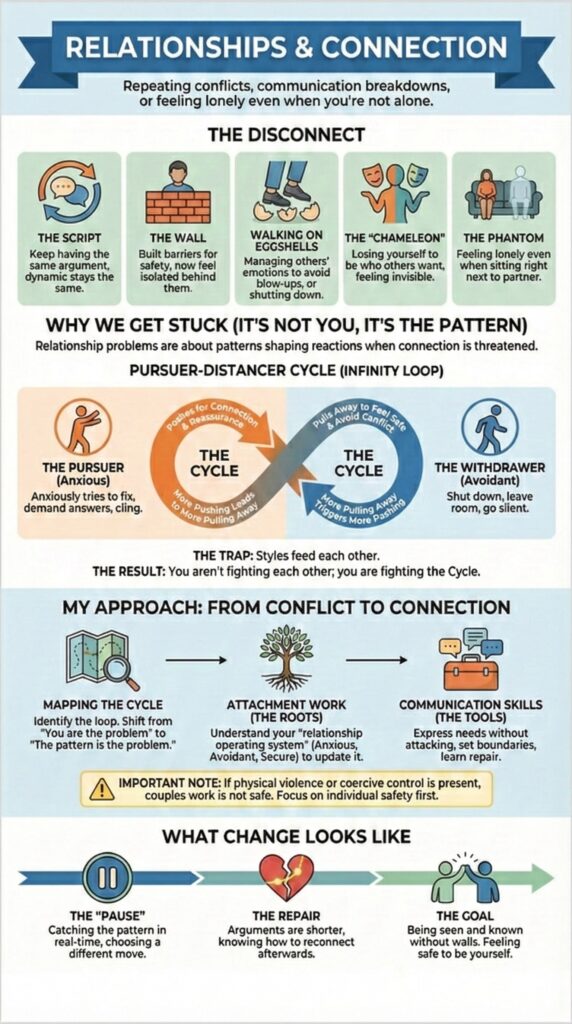
The Disconnect
- The Script: You keep having the same argument. The topic changes (dishes, money, intimacy), but the underlying dynamic is exactly the same every time.
- The Wall: You want connection, but vulnerability feels dangerous. You have built barriers to keep people at a safe distance—but now you feel isolated behind them.
- Walking on Eggshells: You are constantly managing someone else’s emotions to avoid a blow-up, or you shut down completely to keep the peace.
- The “Chameleon”: You lose yourself in relationships. You become who you think the other person wants you to be, abandoning your own needs and preferences, leaving you feeling invisible and resentful.
- The Phantom: You feel lonely even when you are sitting right next to your partner or friends. The conversation stays on the surface.
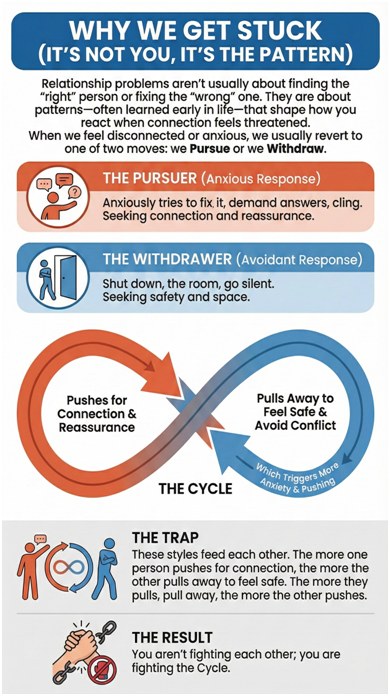
Why We Get Stuck (It's Not You, It's The Pattern)

My Approach: From Conflict to Connection
- The Shift: We move from “You are the problem” to “The pattern is the problem.” We identify your specific triggers and how you typically react when you feel disconnected.
- The Insight: We explore your attachment style (Anxious, Avoidant, or Secure). This isn’t about blaming your parents; it’s about understanding your “relationship operating system” so you can update it.
- The Practice: We learn to express needs without attacking. We learn to listen without defending. We practice setting boundaries—learning to say no and protect your needs without guilt. We work on repair—because healthy relationships still have conflict, they just know how to fix it afterwards.

Ready to Break the Cycle?
The same patterns keep showing up. Let's understand why and build something different.
$150 per 50-minute session - Insurance billing available
What Change Looks Like
Relationship change is gradual.

The "Pause"
You start catching the pattern in real-time. You realize, "I'm doing that thing where I shut down," and you choose a different move.

The Repair
You won't stop arguing forever. But the arguments will be shorter, less damaging, and you will know how to reconnect afterwards.

The Goal
You develop the capacity to be seen and known without the protective walls. You feel safe enough to be yourself.

Page Summary
References
Benoit, D. (2004). Infant-parent attachment: Definition, types, antecedents, measurement and outcome. Paediatrics & Child Health, 9(8), 541–545. https://doi.org/10.1093/pch/9.8.541
Tan, J. S., Hessel, E. T., Loeb, E. L., Schad, M. M., Allen, J. P., & Chango, J. M. (2016). Long-term predictions from early adolescent attachment state of mind to romantic relationship behaviors. Journal of Research on Adolescence, 26(4), 1022–1035. https://doi.org/10.1111/jora.12256
Frequently Asked Questions About Relationship Counselling
Can individual therapy help with my relationship problems even if I'm coming alone?
Yes. Individual therapy can be highly effective for relationship concerns, even when your partner isn’t involved.
I use Acceptance and Commitment Therapy (ACT) to help you focus on what you can control: your own responses, values, and choices. Research shows that when you change your own patterns, it often shifts the entire relationship dynamic.
How it works:
- The Benefit (Your Control): You can change relationship dynamics by changing how you communicate, react to conflict, set boundaries, and make decisions. Individual therapy helps you identify unhelpful patterns, build new skills, and clarify your relationship values.
- The Boundary (What We Can’t Do): Individual therapy cannot “fix” your partner, make someone else change, or resolve systemic couple dynamics that require both people present. If you need to work on specific couple patterns together, I can refer you to couples therapists.
Case Study (Composite scenario for educational purposes)
A client came feeling disconnected from their emotionally distant partner. Through individual therapy, they noticed their pattern of pursuing connection through criticism, which pushed their partner further away. By learning to communicate vulnerability instead of frustration (“I miss feeling close to you” instead of “You never talk to me”), and building a fulfilling life outside the relationship, the dynamic shifted. Their partner became more responsive, and the client felt empowered whether the relationship improved or not.
A Note on Safety:
If you are experiencing abuse or feel unsafe, individual therapy is often the safest place to start. We can help you clarify your safety needs, explore your options confidentially, and connect you with specialized resources.
Ready to change your relationship patterns? Book your first session in Victoria, Langford, Saanich, the Westshore, or Sooke.
Related Questions:
- What therapeutic approaches do you use? ; ACT, mindfulness, SFBT, and other evidence-based methods
- What issues or concerns can you help with? ; Relationships, anxiety, grief, family patterns, and more
- Will I have to talk about things I don’t want to talk about? ; You control the pace and topics, including relationship details
- How long does therapy take to work? ; Understanding realistic timelines for pattern change
- What is a Canadian Certified Counsellor (CCC)? ; Understanding credentials and ethical standards
Service Pages:
- Relationship Counselling for Individuals ; Working on your patterns, boundaries, and communication
- Family of Origin Issues ; Understanding how childhood patterns affect adult relationships
- What is Acceptance and Commitment Therapy (ACT)? ; The primary evidence-based approach used in this practice
- Anxiety Treatment ; Managing relationship anxiety and fear of conflict
Policy Details:
- Informed Consent for Therapy ; See “Therapist Responsibilities” and “Your Rights”
- Privacy Policy & Confidentiality ; See “Confidentiality in Relationship Contexts”
- About Sean Lewis, MA, MDiv, CCC ; Complete credentials and therapeutic approach
Evidence-Based Practice References
1. A-Tjak, J. G. L., et al. “A Meta-Analysis of the Efficacy of Acceptance and Commitment Therapy for Clinically Relevant Mental and Physical Health Problems.” Psychotherapy and Psychosomatics 84, no. 1 (2015): 30-36. https://doi.org/10.1159/000365764 2. Rogge, R. D., et al. “Is Skills Training Necessary for the Primary Prevention of Marital Distress and Dissolution? A 3-Year Experimental Study of Three Interventions.” Journal of Consulting and Clinical Psychology 81, no. 6 (2013): 949-961. https://doi.org/10.1037/a0034209
Can therapy help me repair relationships with family members without them attending sessions?
Yes. You cannot control your family, but you can change the dynamic. Individual therapy is often the most effective way to break old patterns, even if your parents or siblings never set foot in the counselling room.
How it works (The “Mobile” Analogy)
Family Systems Theory views a family like a hanging mobile. If you pull on one piece (you), the entire structure has to shift to accommodate that movement. When you change how you react, set boundaries, or communicate, the old “dance” steps no longer work, forcing others to adjust.
Case Study (Composite scenario for educational purposes)
Sarah’s mother would call multiple times daily with criticism about her parenting choices. Sarah would either argue defensively (escalating the conflict) or avoid calls entirely (creating guilt and more criticism). Through individual therapy, Sarah learned to respond calmly: “Mom, I appreciate your concern. I’m handling this differently than you would, and that’s okay.” Then she’d end the call if criticism continued.
Within weeks, her mother’s calls decreased. The old pattern—criticism met with defensiveness—no longer worked. Sarah’s mother had to adjust her approach because Sarah had changed the “dance.”
What we work on individually:
Using Acceptance and Commitment Therapy (ACT) and mindfulness-based approaches, we help you:
- Stop the Spiral: Learn to pause before reacting to familiar triggers
- Set Boundaries: Establish limits based on self-respect, not guilt
- Differentiate: Separate your emotional reality from your family’s expectations
- Communicate Clearly: Develop skills that reduce defensiveness and conflict
A Critical Note on Safety:
While individual work is powerful, it cannot “fix” abuse or untreated addiction in others. If a relationship is abusive, our goal shifts from repairing the bond to protecting your safety and well-being. Some situations may require additional supports beyond individual therapy.
Ready to change the dynamic? Book your first session in Greater Victoria (Victoria, Langford, Saanich, Westshore, Sooke).
Related Questions:
- Will I have to talk about things I don’t want to talk about? ; You control the pace and topics, always
- Can my therapist share information with family members without my consent? ; Understanding confidentiality with family
- What types of counselling do you offer? ; All therapeutic approaches and clinical specializations
- What if therapy doesn’t work or makes me worse? ; Monitoring progress and your rights
Service Pages:
- Family of Origin Issues ; Healing childhood wounds and breaking generational cycles
- Relationship Counselling ; Improving communication and setting healthy boundaries
- Anxiety Treatment ; Managing anxiety that fuels family conflict
- Trauma & PTSD Therapy ; Processing family trauma and attachment wounds
Therapeutic Approach Pages:
- Acceptance and Commitment Therapy ; Values-based approach to relationship patterns
- Family Systems Theory ; Understanding interconnected family dynamics
- Mindfulness Therapy ; Developing awareness in relationships
Policy Details:
- Informed Consent for Therapy ; See: “Confidentiality and Its Limits” regarding family involvement
- Privacy Policy & Confidentiality ; See: “Involving Family Members in Treatment”
- Client Rights & Responsibilities ; Your right to control who is involved in your care
Evidence-Based Practice References
1. Kerr, M. E., & Bowen, M. Family Evaluation: An Approach Based on Bowen Theory. New York: W. W. Norton & Company, 1988\. 2. Dattilio, F. M. Cognitive-Behavioral Therapy with Couples and Families: A Comprehensive Guide for Clinicians. New York: Guilford Press, 2010\. 3. Canadian Counselling and Psychotherapy Association (CCPA). “Code of Ethics (2020).” Article B2 “Confidentiality.” Ottawa: CCPA, 2020\. https://www.ccpa-accp.ca/wp-content/uploads/2020/05/CCPA-2020-Code-of-Ethics-E-Book-EN.pdf
When should I consider individual relationship counselling instead of couples therapy?
Individual relationship counselling is often the better choice when your partner is unwilling to attend, you’re deciding whether to stay or leave, you need to work on your own patterns first, or safety is a concern. Working individually lets you focus on what you can control: your choices, boundaries, and relationship patterns.
Consider Individual Counselling If:
- You’re deciding whether to stay or leave the relationship
- Your partner refuses to attend or isn’t ready for therapy
- You want to work on your own attachment patterns and family-of-origin wounds first
- Safety is a concern (see below)
The Safety Factor (Critical)
If there is abuse, emotional manipulation, coercive control, or fear in your relationship, individual therapy is the appropriate and safer starting point. Couples therapy can be dangerous in abusive relationships because it may:
- Provide the abusive partner with information to use against you
- Inadvertently reinforce power imbalances
- Imply both partners share equal responsibility (which isn’t true in abuse)
Individual therapy provides a protected space to build self-worth, clarify reality, set boundaries, and plan for safety without risk.
How Individual Work Helps Relationships
The benefit: You can identify your attachment patterns and relationship templates, develop boundaries and communication skills you control, clarify your actual values and needs, and build self-worth independent of your partner’s validation. Research shows individual therapy can significantly improve relationship functioning even when only one partner attends.
The “hard part”: When you change your role in the relationship dynamic (stop people-pleasing, set firmer boundaries), your partner may resist. We use Acceptance and Commitment Therapy (ACT) and family-of-origin work to help you tolerate this friction while maintaining your growth.
The reality: Individual counselling cannot fix your partner’s behavior or guarantee they’ll change in response to your growth. Deep pattern change typically takes 6-12 months of consistent work.
Ready to work on your relationship patterns?
Book your first session in Victoria, Langford, Saanich, the Westshore, or Sooke to clarify whether individual relationship counselling is the right starting point for you.
(If you are currently in an unsafe relationship and need immediate support, contact the VictimLink BC crisis line at 1-800-563-0808, available 24/7.)
Related Questions
- Can therapy help if I keep ending up in similar unhealthy relationship patterns? ; Understanding and changing your relationship cycles
- Can individual therapy help with my relationship problems even if I’m coming alone? ; Working on patterns when your partner isn’t involved
- What issues or concerns can you help with? ; Relationships, anxiety, grief, family patterns, and more
- How long does therapy take to work? ; Understanding realistic timelines for deep pattern change
- What is Acceptance and Commitment Therapy (ACT)? ; The primary evidence-based approach used in this practice
Service Pages
- Relationship Counselling for Individuals ; Working on your patterns, boundaries, and choices when couples therapy isn’t the right fit
- Family of Origin Issues ; Understanding how childhood patterns affect adult relationships
- Anxiety Treatment ; Managing relationship anxiety and fear of conflict
- Trauma & PTSD Therapy ; Healing from past relationship trauma that affects current relationships
Policy Details
- Informed Consent for Therapy ; See “Therapist Responsibilities” and “Your Rights”
- Privacy Policy & Confidentiality ; See “Confidentiality in Relationship Contexts”
- About Sean Lewis, MA, MDiv, CCC ; Complete credentials, background in ministry and military service
- Crisis & Safety Resources ; Immediate support if you are in an unsafe relationship
Evidence-Based Practice References
1. Snyder, D. K., Castellani, A. M., & Whisman, M. A. “Current Status and Future Directions in Couple Therapy.” Annual Review of Psychology 57 (2006): 317-344. https://doi.org/10.1146/annurev.psych.56.091103.070154 2. Johnson, S. M. “The Practice of Emotionally Focused Couple Therapy: Creating Connection.” 2nd ed. New York: Brunner-Routledge, 2004\. 3. Mikulincer, M., & Shaver, P. R. “Attachment in Adulthood: Structure, Dynamics, and Change.” New York: Guilford Press, 2007\. 4. Stith, S. M., Rosen, K. H., & McCollum, E. E. “Effectiveness of Couples Treatment for Spouse Abuse.” Journal of Marital and Family Therapy 30, no. 4 (2004): 407-426. https://doi.org/10.1111/j.1752-0606.2004.tb01255.x
What relationship issues can individual therapy help with?
Individual therapy can help with communication patterns, boundaries, repetitive relationship cycles, attachment wounds, family-of-origin issues, and deciding whether to stay or leave. You don’t need your partner present to work on your contribution to relationship dynamics; therapy helps you change what you can control: your patterns, responses, and choices.
Common Relationship Issues We Address Individually
Communication and boundaries:
- Difficulty expressing needs without guilt or defensiveness
- Setting boundaries that get respected
- Conflict patterns (criticism, stonewalling, shutting down)
Repetitive patterns and attachment:
- Consistently choosing unavailable or emotionally distant partners
- People-pleasing, codependency, or losing yourself in relationships
- Anxious or avoidant attachment patterns from past experiences
Family-of-origin wounds:
- Childhood experiences creating templates for adult relationships
- Repeating unhealthy dynamics from your family
- Unmet childhood needs showing up as adult relationship patterns
Relationship decisions:
- Deciding whether to stay or leave
- Processing breakups or preparing for difficult conversations
- Loneliness and difficulty forming connections
The Safety Factor (Critical)
If your relationship involves abuse, emotional manipulation, coercive control, or fear, individual therapy is the appropriate and safer starting point. Couples therapy is contraindicated in abusive situations.
How Individual Work Helps
Research shows that when one partner develops better emotional regulation, communication skills, and self-awareness, relationship dynamics often shift. Using Acceptance and Commitment Therapy (ACT) and family-of-origin work, we help you identify your patterns, build practical skills, and clarify your relationship values.
The reality: Individual therapy cannot fix your partner’s behavior or guarantee they’ll change. But changing your steps in the relationship dance often changes the whole dynamic; sometimes improving the relationship, sometimes revealing incompatibility.
Learn more about individual relationship counselling ; comprehensive guide to working on relationships when coming alone
Ready to work on your relationship patterns?
Book your first session in Victoria, Langford, Saanich, the Westshore, or Sooke to explore how individual therapy can help with your specific relationship concerns.
(If you are currently in an unsafe relationship, contact VictimLink BC at 1-800-563-0808, available 24/7.)
Related Questions
- When should I consider individual relationship counselling instead of couples therapy? ; Deciding between individual work and couples therapy
- Can therapy help if I keep ending up in similar unhealthy relationship patterns? ; Understanding and changing your relationship cycles
- Can individual therapy help with my relationship problems even if I’m coming alone? ; Working on patterns when your partner isn’t involved
- What is Acceptance and Commitment Therapy (ACT)? ; The primary evidence-based approach used in this practice
- How long does therapy take to work? ; Realistic timelines for deep pattern change
Service Pages
- Relationship Counselling for Individuals ; Comprehensive guide including detailed examples, mechanisms, and clinical approach
- Family of Origin Issues ; Understanding how childhood patterns affect adult relationships
- Anxiety Treatment ; Managing relationship anxiety and fear of vulnerability
- Trauma & PTSD Therapy ; Healing from past relationship trauma
- Family Systems Theory ; Understanding relationship patterns and family dynamics
Policy Details
- Informed Consent for Therapy ; See “Therapist Responsibilities” and “Your Rights”
- Privacy Policy & Confidentiality ; See “Confidentiality in Relationship Contexts”
- About Sean Lewis, MA, MDiv, CCC ; Complete credentials and therapeutic approach
- Crisis & Safety Resources ; Immediate support if you are in an unsafe relationship
Evidence-Based Practice References
1. Baucom, D. H., et al. “A Comparison of Traditional versus Integrative Behavioral Couple Therapy: 5-Year Follow-Up.” Journal of Consulting and Clinical Psychology 83, no. 3 (2015): 494-507. https://doi.org/10.1037/a0039054 2. Mikulincer, M., & Shaver, P. R. “Attachment in Adulthood: Structure, Dynamics, and Change.” 2nd ed. New York: Guilford Press, 2016\. 3. Johnson, S. M. “Attachment Theory in Practice: Emotionally Focused Therapy (EFT) with Individuals, Couples, and Families.” New York: Guilford Press, 2019\.
Can therapy help if I keep ending up in similar unhealthy relationship patterns?
Yes. Therapy is highly effective for breaking repetitive relationship cycles because it helps you understand why you’re drawn to certain dynamics and gives you tools to make different choices.
I combine family of origin work with Acceptance and Commitment Therapy (ACT) to help you map where these patterns started and build the psychological flexibility to change them. Research shows that understanding your attachment patterns and relationship templates from childhood significantly predicts better relationship outcomes. Deep pattern change typically takes 6–12 months of consistent therapy, though you’ll likely notice shifts earlier.
How therapy breaks unhealthy relationship patterns:
- The Benefit (Breaking the Cycle): You can identify the childhood needs you’re unconsciously trying to meet through adult partners, recognize your specific patterns and where they come from, learn to notice red flags earlier, and build skills to choose partners aligned with your actual values.
- The “Hard Part”: When you’re used to chaos or unavailability, healthy relationships can feel “boring,” “wrong,” or anxiety-inducing at first. Therapy helps you tolerate this discomfort until healthy becomes your new normal.
- The Boundary (What We Can’t Do): Therapy cannot erase decades of relationship templates overnight or guarantee you’ll never be attracted to the “wrong” person again. Pattern change takes time and practice with likely setbacks.
Case Study (Composite scenario for educational purposes)
A client kept dating partners who were emotionally unavailable, then feeling frustrated and abandoned. Through therapy, they recognized this mirrored their relationship with a distant parent; they were unconsciously trying to “win” the love they never got as a child. By understanding this pattern, grieving what they missed, and clarifying their actual relationship values (emotional presence, reciprocity), they began noticing red flags earlier. The hard part was tolerating the discomfort when emotionally available partners felt “too much” or “smothering” at first. Over time, they learned to recognize this as their nervous system adjusting to something healthy but unfamiliar, and they began choosing partners who could actually meet their needs.
A Note on Safety:
If your relationship patterns involve abuse, manipulation, or feeling unsafe, breaking the cycle is still possible. Individual therapy is a safe place to build the self-worth and skills needed to choose differently. We can also connect you with specialized resources for support.
Ready to break the cycle? Book your first session in Victoria, Langford, Saanich, the Westshore, or Sooke.
Related Questions:
- Can individual therapy help with my relationship problems even if I’m coming alone? ; Working on patterns when your partner isn’t involved
- What issues or concerns can you help with? ; Relationships, anxiety, grief, family patterns, and more
- How long does therapy take to work? ; Understanding realistic timelines for deep pattern change
- What is Acceptance and Commitment Therapy (ACT)? ; The primary evidence-based approach used in this practice
- Will I have to talk about things I don’t want to talk about? ; You control the pace, including exploring past relationships
Service Pages:
- Family of Origin Issues ; Understanding how childhood patterns affect adult relationships
- Relationship Counselling for Individuals ; Working on your patterns, boundaries, and choices
- What is Acceptance and Commitment Therapy (ACT)? ; The primary evidence-based approach used in this practice
- Anxiety Treatment ; Managing relationship anxiety and fear of repeating patterns
Policy Details:
- Informed Consent for Therapy ; See “Therapist Responsibilities” and “Your Rights”
- Privacy Policy & Confidentiality ; See “Confidentiality in Relationship Contexts”
- About Sean Lewis, MA, MDiv, CCC ; Complete credentials and therapeutic approach
Evidence-Based Practice References
1. Mikulincer, M., & Shaver, P. R. “Attachment in Adulthood: Structure, Dynamics, and Change.” New York: Guilford Press, 2007\. 2. Bowlby, J. “A Secure Base: Parent-Child Attachment and Healthy Human Development.” Developmental Psychology 25, no. 1 (1988): 23-40. https://doi.org/10.1037/0012-1649.25.1.23 3. Tasca, G. A., et al. “Attachment Scales Predict Outcome in a Randomized Controlled Trial of Two Group Therapies for Binge Eating Disorder.” Psychotherapy Research 17, no. 5 (2007): 600-610. https://doi.org/10.1080/10503300701376076
Can individual therapy help me with assertiveness and setting boundaries?
Yes. Learning to set boundaries and communicate assertively are core skills we develop in individual therapy; you don’t need anyone else present to change how you show up in relationships, at work, or with family.
How Boundaries Work: The “Property Line” Analogy
Think of healthy boundaries like property lines on a map. They define where you end and others begin; what’s your responsibility and what’s not; what you’ll accept and what you won’t.
- Porous Boundaries (Enmeshment): You feel responsible for everyone else’s emotions; everyone’s business was everyone else’s
- Rigid Boundaries (Isolation): High walls with no emotional connection
- Healthy Boundaries: Clear lines that protect what you value while allowing genuine connection
Assertiveness is simply learning to name your property lines clearly and kindly, without apologizing for their existence.
The “Good Daughter” Trap Case Study (Composite scenario for educational purposes)
Jennifer’s mother would call multiple times daily expecting immediate responses, then guilt-trip her when Jennifer was busy. Jennifer felt torn between being a “good daughter” and protecting her own time. Through therapy, she learned to say: “Mom, I love you and I want to stay connected. I’m going to check messages twice a day; morning and evening. If there’s an emergency, text ‘URGENT.'”
The first week was uncomfortable (her mother pushed back), but Jennifer held the boundary. Within two weeks, her mother adjusted because the old pattern; demand followed by guilty compliance; no longer worked.
What We Work On:
Using Acceptance and Commitment Therapy (ACT) and mindfulness-based approaches, we help you:
- Identify values: Boundaries protect what matters to you; differentiate kindness (a value) from people-pleasing (a fear response)
- Recognize guilt vs. wrongdoing: Feeling guilty doesn’t mean you did something wrong
- Practice “kind clarity”: Say no without aggression, defensiveness, or over-explaining
- Tolerate discomfort: Others may not like your boundaries; that’s not your responsibility to fix
Where Boundary Issues Come From:
Most boundary struggles trace back to family of origin patterns; how your family handled conflict, what happened when you said “no” as a child. If you learned that setting limits meant abandonment, criticism, or punishment, your nervous system will resist boundaries even when they’re healthy. Individual therapy helps rewire these patterns.
As a Canadian Certified Counsellor (CCC) with a Master of Divinity and ten years of pastoral ministry, I understand how faith communities and family systems can complicate boundary-setting; especially when teachings about selflessness, honor, or submission were used to override personal limits.
If you’re in immediate crisis or thinking about harming yourself, call the Vancouver Island Crisis Line at 1-888-494-3888 (24/7).
👉 Ready to learn assertiveness skills? Book your first session in Greater Victoria (Victoria, Langford, Saanich, Westshore, Sooke).
Related Questions:
- Can therapy help me repair relationships with family members without them attending? ; How individual work changes relationship dynamics
- Will I have to talk about things I don’t want to talk about? ; You control the pace and topics, always
- What should I expect in my first session for relationship counselling? ; Understanding relationship patterns and communication
- What types of counselling do you offer? ; All therapeutic approaches and clinical specializations
Service Pages:
- Relationship Counselling ; Improving communication and setting healthy boundaries
- Family of Origin Issues ; Healing patterns learned in childhood
- Anxiety Treatment ; Managing people-pleasing anxiety and fear of conflict
- Stress & Burnout ; Learning to say no without guilt
Therapeutic Approach Pages:
- Acceptance and Commitment Therapy ; Values-based approach to boundary-setting
- Family Systems Theory ; Understanding how family patterns shape boundaries
- Mindfulness Therapy ; Developing awareness of boundary violations
Policy Details:
- Informed Consent for Therapy ; See: “Your Rights as a Client” and “Confidentiality”
- Privacy Policy & Confidentiality ; See: “How We Protect Your Information”
- Client Rights & Responsibilities ; Your rights in the therapeutic relationship
Evidence-Based Practice References
1. Hayes, S. C., Strosahl, K. D., & Wilson, K. G. Acceptance and Commitment Therapy: The Process and Practice of Mindful Change (2nd ed.). New York: Guilford Press, 2011\. \[Foundational ACT text on values clarification and committed action\] 2. Linehan, M. M. DBT Skills Training Manual (2nd ed.). New York: Guilford Press, 2014\. \[Interpersonal effectiveness skills including assertiveness and boundary-setting strategies\] 3. Cloud, H., & Townsend, J. Boundaries: When to Say Yes, How to Say No to Take Control of Your Life. Grand Rapids, MI: Zondervan, 1992\. \[Widely-used resource on healthy boundaries from Christian psychology perspective\] 4. Canadian Counselling and Psychotherapy Association (CCPA). “Code of Ethics (2020).” Article A6 “Respect for Client Autonomy.” Ottawa: CCPA, 2020\. https://www.ccpa-accp.ca/wp-content/uploads/2020/05/CCPA-2020-Code-of-Ethics-E-Book-EN.pdf
What should I expect in my first session for relationship counselling?
Your first session focuses on understanding the relationship patterns causing difficulty and clarifying what you want to change. Most clients come alone for individual relationship work; you don’t need your partner present to improve how you show up in relationships.
As a Canadian Certified Counsellor (CCC) with a Master of Divinity and ten years of pastoral ministry experience, I understand how family patterns and learned communication styles shape adult relationships; and how individual work can shift those dynamics. It’s normal to feel uncertain or anxious before your first session; that’s often a sign the issues matter to you.
How the First Session Works: The “Relationship Map” Approach
Think of the first session as creating a map of your relationship patterns. We identify where the conflicts happen (communication breakdowns, boundary violations, recurring arguments), what keeps those patterns stuck (anxious attachment; patterns learned from how your family of origin handled conflict; unspoken expectations), and where you want to go (healthier boundaries, clearer communication, feeling safe and valued).
Case Study (Composite scenario for educational purposes)
Marcus came in frustrated about constant arguments with his wife over household responsibilities. In the first session, we didn’t focus on who was “right” about the dishes. Instead, we explored: What does the conflict represent for you? (For Marcus: feeling unappreciated). How did your family of origin handle conflict? (His parents avoided confrontation entirely). What pattern are you stuck in now? (Passive-aggressive silence followed by explosive arguments).
Research on relationship patterns shows these cycles; like pursue-withdraw or criticism-defensiveness; are predictable and changeable through individual work. This gave us clear targets for Marcus’s therapy, even without his wife attending.
What We Cover in Session One (50 minutes):
- Current relationship concerns: What’s happening now that prompted you to seek help
- Relationship history: Key patterns across past and current relationships
- Communication style: How you typically express needs, handle conflict, and set boundaries
- Family of origin influences: What you learned about relationships growing up
- Your goals: What would be different if therapy works
- Initial plan: Whether individual work makes sense, or if couples sessions would be beneficial later
Important Notes:
Individual vs. Couples Counselling: Most relationship work starts individually. Using Acceptance and Commitment Therapy (ACT) and Family Systems Theory, you can learn communication skills, set boundaries, and change your patterns without your partner’s involvement. If couples counselling becomes appropriate later, we’ll discuss that transition; both partners would need to consent and confidentiality works differently in couples sessions.
You’re Not Expected to Have Answers: Many clients feel stuck or confused about what’s wrong. The first session helps clarify patterns you may not consciously recognize.
If relationship patterns are affecting your mental health, sense of identity, or your ability to connect authentically with others, individual therapy can help you understand these dynamics and build healthier ways of showing up; at your own pace.
Ready to map your relationship patterns? Book your first session in Greater Victoria (Victoria, Langford, Saanich, Westshore, Sooke).
Related Questions:
- What should I expect in my first therapy session? ; General first session overview for all therapy types
- Can therapy help me repair relationships with family members without them attending? ; How individual work changes relationship dynamics
- Will I have to talk about things I don’t want to talk about? ; You control the pace and topics, always
- How long does therapy take to work? ; Timeline expectations for relationship work
Service Pages:
- Relationship Counselling ; Individual work for improving communication and setting boundaries
- Family of Origin Issues ; How childhood patterns affect adult relationships
- Anxiety Treatment ; Managing relationship anxiety and fear of abandonment
- Trauma & PTSD Therapy ; Processing attachment wounds and relationship trauma
Therapeutic Approach Pages:
- Acceptance and Commitment Therapy ; Values-based approach to relationship patterns
- Family Systems Theory ; Understanding how family patterns shape relationships
- Mindfulness Therapy ; Developing awareness in relationship conflicts
- Narrative Therapy ; Reshaping relationship stories and identities
Policy Details:
- Informed Consent for Therapy ; See: “Confidentiality and Its Limits” and “What to Expect”
- Privacy Policy & Confidentiality ; See: “Individual vs. Couples Confidentiality”
- Client Rights & Responsibilities ; Your rights in the therapeutic relationship
Evidence-Based Practice References
1. Johnson, S. M. The Practice of Emotionally Focused Couple Therapy: Creating Connection (3rd ed.). New York: Routledge, 2019\. \[Attachment-based framework for understanding relationship patterns applicable to individual therapy\] 2. Gottman, J. M., & Gottman, J. S. “The Natural Principles of Love.” Journal of Family Theory & Review 9, no. 1 (2017): 7-26. https://doi.org/10.1111/jftr.12182 \[Research on relationship patterns, communication skills, and predictable conflict cycles\] 3. Canadian Counselling and Psychotherapy Association (CCPA). “Code of Ethics (2020).” Article B “Confidentiality” and Article A6 “Respect for Client Autonomy.” Ottawa: CCPA, 2020\. https://www.ccpa-accp.ca/wp-content/uploads/2020/05/CCPA-2020-Code-of-Ethics-E-Book-EN.pdf 4. BC Association of Clinical Counsellors (BCACC). “Standards of Clinical Practice: Care and Consent.” Section 1.5 “Informed Consent Process.” Vancouver: BCACC, effective November 1, 2023\. https://bcacc.ca/wp-content/uploads/2023/07/01-BCACC-Standards-of-Clinical-Practice\_Care-and-Consent-Effective-Nov.-1-2023.pdf
Can therapy help with loneliness or feeling disconnected from others?
Yes. Therapy helps you understand why connection feels difficult and builds the skills to create meaningful relationships. Loneliness can come from lack of people in your life, or difficulty letting people in even when they’re nearby.
How Disconnection Works: The “Island” Analogy
Think of chronic loneliness like living on an island. The bridges to other islands either collapsed long ago (trauma, loss, rejection) or were never built in the first place (childhood neglect, insecure attachment). Some people build walls around their island (avoidance, mistrust), while others stand at the shore desperately waving but not knowing how to build a bridge (social anxiety, fear of rejection).
The “Surrounded But Alone” Pattern (Composite scenario for educational purposes)
David felt “behind glass” even with his partner and coworkers nearby. Through therapy, he learned his family of origin taught him sharing meant burdening others. He started taking small risks—texting a friend when struggling, sharing one real thing with his partner—and the “glass wall” started to crack.
What We Work On:
Using Acceptance and Commitment Therapy (ACT) and mindfulness-based approaches, we help you:
- Identify the pattern: Is loneliness about lack of people, or difficulty letting people in?
- Challenge avoidance: Anxiety says “stay home;” we practice moving toward connection despite discomfort
- Build authentic sharing: Moving from surface conversations to real vulnerability
- Heal attachment wounds: Understanding how childhood experiences taught you connection isn’t safe
- Distinguish loneliness from depression: Sometimes isolation is a symptom; we address the root cause
Loneliness is not a character flaw; it’s a signal that something important is missing. If feeling disconnected is affecting your mental health or ability to enjoy life, individual therapy can help you understand the barriers and practice connection at your own pace.
If you’re in immediate crisis or thinking about harming yourself, call the Vancouver Island Crisis Line at 1-888-494-3888 (24/7).
👉 Ready to rebuild connection? Book your first session in Greater Victoria (Victoria, Langford, Saanich, Westshore, Sooke).
Related Questions:
- Can therapy help me repair relationships with family members without them attending? ; How individual work changes relationship dynamics
- Can individual therapy help me with assertiveness and setting boundaries? ; Learning to show up authentically in relationships
- What should I expect in my first session for relationship counselling? ; Understanding relationship patterns and connection
- What are signs I need therapy? ; Recognizing when isolation is affecting your wellbeing
Service Pages:
- Relationship Counselling ; Building authentic connections and communication skills
- Anxiety Treatment ; Managing social anxiety and fear of rejection
- Depression Counselling ; Addressing isolation and loss of interest in connection
- Family of Origin Issues ; Healing attachment wounds from childhood
Therapeutic Approach Pages:
- Acceptance and Commitment Therapy ; Moving toward connection despite anxiety
- Mindfulness Therapy ; Developing present-moment awareness in relationships
- Family Systems Theory ; Understanding attachment patterns and connection
Policy Details:
- Informed Consent for Therapy ; See: “What to Expect” and “Your Rights as a Client”
- Privacy Policy & Confidentiality ; See: “How We Protect Your Information”
- Client Rights & Responsibilities ; Your rights in the therapeutic relationship
Evidence-Based Practice References
1. Cacioppo, J. T., & Patrick, W. Loneliness: Human Nature and the Need for Social Connection. New York: W. W. Norton & Company, 2008\. 2. Murthy, V. H. Together: The Healing Power of Human Connection in a Sometimes Lonely World. New York: Harper Wave, 2020\. 3. Hayes, S. C., Strosahl, K. D., & Wilson, K. G. Acceptance and Commitment Therapy: The Process and Practice of Mindful Change (2nd ed.). New York: Guilford Press, 2011\. 4. Canadian Counselling and Psychotherapy Association (CCPA). “Code of Ethics (2020).” Article A6 “Respect for Client Autonomy.” Ottawa: CCPA, 2020\. https://www.ccpa-accp.ca/wp-content/uploads/2020/05/CCPA-2020-Code-of-Ethics-E-Book-EN.pdf
Can therapy help with people-pleasing or feeling burnt out by others' expectations?
Yes. Therapy is highly effective for breaking people-pleasing patterns because we treat them not as personality flaws, but as learned safety mechanisms; often called the “Fawn Response.” Using Acceptance and Commitment Therapy (ACT), we help you retrain your nervous system to move from automatically saying “yes” to keep the peace, to intentionally choosing “no” to protect your wellbeing.
Research shows that ACT significantly improves psychological flexibility and reduces emotional exhaustion in people experiencing burnout.
The Cost of People-Pleasing
You might recognize these signs:
- The “Resentment Barometer”: You say yes nicely, but feel angry or exhausted immediately after
- Managing others’ emotions: Feeling responsible for preventing their disappointment or anger
- Chameleon-ing: Changing your personality or opinions to match whoever is in the room
- Lost sense of self: Difficulty identifying your own needs because you’re so focused on everyone else’s
How Therapy Helps
The Benefit: You learn to identify your own values separate from others’ demands, recognize the automatic “yes” pattern before it happens, build skills to communicate boundaries clearly, and tolerate the discomfort of saying “no” without caving in.
The Hard Part: When you start setting boundaries, people who benefited from your people-pleasing may resist or guilt-trip you. This can feel terrifying, especially if your nervous system learned that others’ displeasure equals danger. This is not a sign you are doing it wrong; it is a sign you are doing it right. Therapy supports you through this friction and helps you recognize that healthy relationships can survive your boundaries.
The Reality: Changing people-pleasing patterns doesn’t mean becoming selfish or uncaring. It means learning to care for yourself with the same energy you give others. Rewiring these deeply ingrained patterns from childhood and family systems typically takes 6-12 months.
Learn more about addressing people-pleasing, burnout, and setting boundaries ; comprehensive guide on our Stress & Burnout service page
Ready to live for yourself, not just for others?
Book your first session in Victoria, Langford, Saanich, the Westshore, or Sooke to work on boundaries, values clarification, and breaking people-pleasing patterns.
Related Questions
- What relationship issues can individual therapy help with? ; Communication, boundaries, and relationship patterns
- Can therapy help if I keep ending up in similar unhealthy relationship patterns? ; Understanding and changing relationship cycles
- What is Acceptance and Commitment Therapy (ACT)? ; Values clarification, defusion from guilt, and psychological flexibility
- How long does therapy take to work? ; Realistic timelines for deep pattern change
- Will I have to talk about things I don’t want to talk about? ; You control the pace of therapy
Service Pages
- Stress & Burnout ; Comprehensive guide to people-pleasing, emotional exhaustion, and the Fawn Response
- Relationship Counselling for Individuals ; Working on boundaries and communication patterns
- Family of Origin Issues ; Understanding how childhood patterns create people-pleasing behaviors
- Anxiety Treatment ; Managing the anxiety that comes with boundary-setting
- What is Acceptance and Commitment Therapy (ACT)? ; Detailed explanation of values clarification, defusion, and willingness practices
Policy Details
- Informed Consent for Therapy ; See “Therapist Responsibilities” and “Your Rights”
- Privacy Policy & Confidentiality ; Your sessions are confidential
- About Sean Lewis, MA, MDiv, CCC ; Complete credentials and therapeutic approach
Evidence-Based Practice References
1. Hayes, S. C., Strosahl, K. D., & Wilson, K. G. “Acceptance and Commitment Therapy: The Process and Practice of Mindful Change.” 2nd ed. New York: Guilford Press, 2012\. 2. Lloyd, J., Bond, F. W., & Flaxman, P. E. “The Value of Psychological Flexibility: Examining Psychological Mechanisms Underpinning a Cognitive Behavioural Therapy Intervention for Burnout.” Work & Stress 27, no. 2 (2013): 181-199. https://doi.org/10.1080/02678373.2013.782157 3. Walker, P. “Complex PTSD: From Surviving to Thriving.” Azure Coyote, 2013\. (Fawn Response conceptualization)
Can therapy help with depression or anxiety linked to relationship stress?
Yes. Relationship stress and mental health often fuel each other. Therapy helps you break that cycle, allowing you to stabilize your own well-being even if your partner isn’t ready to change.
The “Feedback Loop” of Conflict
Think of your relationship and mental health as a feedback loop:
1. Conflict Occurs: A fight or tension triggers stress 2. Anxiety Spikes: You feel panic, “walk on eggshells,” or shut down 3. Depression Sets In: Chronic exhaustion from managing the stress leads to hopelessness 4. The Loop Tightens: Depression makes you less able to handle the next conflict, and the cycle repeats
How We Break the Cycle (Individual Work)
You don’t need your partner in the room to change your part of the dynamic. Using Acceptance and Commitment Therapy (ACT), we help you:
- Stop Absorbing Emotions: Learn to stay grounded even when your partner is upset (distress tolerance)
- Identify Triggers: Understand why certain fights trigger deep abandonment or “not good enough” fears
- Differentiate: Clarify what is your responsibility to fix, and what is your partner’s
Individual vs. Couples Therapy: Which Do I Need?
- Choose Individual Therapy: If you are feeling lost, depressed, or need to stabilize your own anxiety or depression first
- Choose Couples Counselling: If both partners are safe, willing, and ready to work on the dynamic together
As a Canadian Certified Counsellor (CCC), I help you develop these skills at your own pace through individual therapy or relationship counselling.
If you’re in immediate crisis or thinking about harming yourself, call the Vancouver Island Crisis Line at 1-888-494-3888 (24/7).
Ready to find stability? Book your first session in Greater Victoria (Victoria, Langford, Saanich, Westshore, Sooke).
Evidence-Based Practice References
1. Whisman, M. A., & Uebelacker, L. A. “Prospective Associations Between Marital Discord and Depressive Symptoms in Middle-Aged and Older Adults.” Psychology and Aging 24, no. 1 (2009): 184-189. https://doi.org/10.1037/a0014759 2. Priest, J. B. “A Bowen Family Systems Model of Generalized Anxiety Disorder and Romantic Relationship Distress.” Journal of Marital and Family Therapy 41, no. 3 (2015): 340-353. https://doi.org/10.1111/jmft.12063 3. Hayes, S. C., Strosahl, K. D., & Wilson, K. G. Acceptance and Commitment Therapy: The Process and Practice of Mindful Change (2nd ed.). New York: Guilford Press, 2011\. 4. Canadian Counselling and Psychotherapy Association (CCPA). “Code of Ethics (2020).” Article A6 “Respect for Client Autonomy.” Ottawa: CCPA, 2020\. https://www.ccpa-accp.ca/wp-content/uploads/2020/05/CCPA-2020-Code-of-Ethics-E-Book-EN.pdf
Individual Relationship Counselling; You Don’t Need Your Partner Here
Why do I keep choosing the wrong person? Why do I shut down during arguments? My partner says I am emotionally unavailable and maybe they are right. You might be here because you wanted couples counselling but your partner will not go—or because you are starting to wonder whether the problem in your relationships is you.
Sean Lewis spent years in pastoral ministry walking with people through communication breakdowns, attachment wounds, and relational patterns rooted in family history. His experience across military, trades, and church cultures showed him how each environment shapes connection—from emotional restriction to over-functioning to the loneliness of never being fully known.
This is individual relationship therapy, not couples counselling. Sean works through Acceptance and Commitment Therapy (ACT) and narrative therapy to help you understand the patterns you carry, where they came from, and how to build connections aligned with your values. Research on attachment theory and ACT supports this approach for codependency, relationship anxiety, and recurring relational cycles.
If every relationship ends the same way, Sean offers relationship counselling in Victoria, BC, from his Colwood office, with virtual sessions across British Columbia. Sessions are covered by most extended health plans through the CCPA. Book a session.