Stress & Burnout Therapy
 Signs
Signs Why
Why Approach
 Outcomes
 Summary
 FAQs
FAQs
Signs of Burnout & Chronic Stress
Common experiences include:
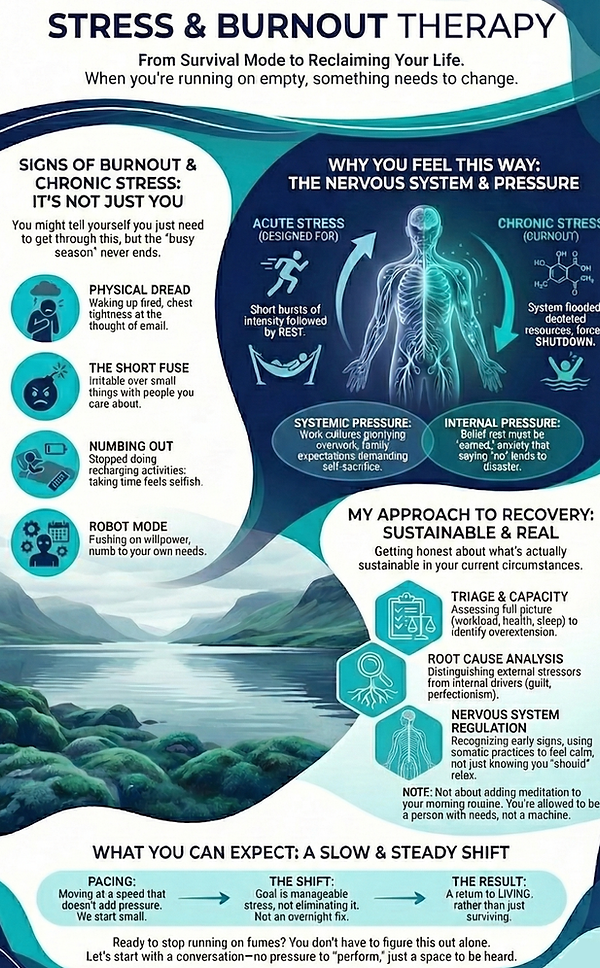
- Physical Dread: You wake up already tired. The thought of checking your email makes your chest tight.
- The Short Fuse: You feel irritable with people you care about over small things that normally wouldn’t matter.
- Numbing Out: You’ve stopped doing the things that used to recharge you because you don’t have the energy, or because taking time for yourself feels selfish.
- “Robot Mode”: You’re pushing through on willpower alone—hitting every deadline but forgetting to eat lunch; managing everyone else’s needs but numb to your own.
- The Short Fuse: You feel irritable with people you care about over small things that normally wouldn’t matter.
- Numbing Out: You’ve stopped doing the things that used to recharge you because you don’t have the energy, or because taking time for yourself feels selfish.
- “Robot Mode”: You’re pushing through on willpower alone—hitting every deadline but forgetting to eat lunch; managing everyone else’s needs but numb to your own.
Why You Feel This Way
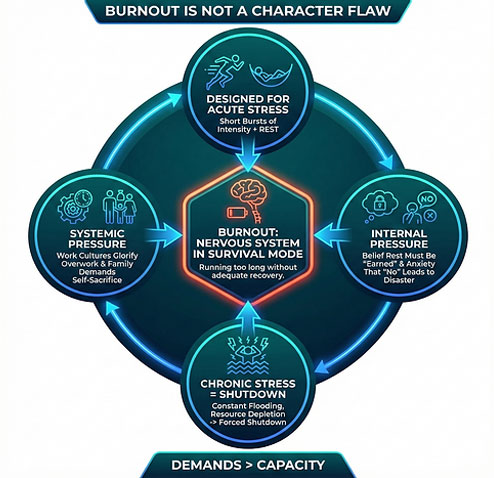
It is what happens when your nervous system has been running in survival mode for too long without adequate recovery.
Your body was designed to handle acute stress—short bursts of intensity followed by rest. But chronic stress keeps your system flooded with stress hormones, depleting your resources until your body forces a shutdown.
Often, burnout develops because the demands on you genuinely exceed your capacity. This is usually compounded by two factors:
- Systemic Pressure: Work cultures that glorify overwork and family expectations that demand self-sacrifice.
- Internal Pressure: The belief that rest must be “earned,” or the anxiety that saying “no” will lead to disaster.
Your body was designed to handle acute stress—short bursts of intensity followed by rest. But chronic stress keeps your system flooded with stress hormones, depleting your resources until your body forces a shutdown.
Often, burnout develops because the demands on you genuinely exceed your capacity. This is usually compounded by two factors:
- Systemic Pressure: Work cultures that glorify overwork and family expectations that demand self-sacrifice.
- Internal Pressure: The belief that rest must be “earned,” or the anxiety that saying “no” will lead to disaster.
My Approach to Burnout Therapy

My Approach to Burnout Therapy
- Triage & Capacity: We look at the full picture; workload, relationships, health, and sleep to see where you are overextending.
- Root Cause Analysis: We distinguish between external stressors (which need practical boundaries and negotiation) and internal drivers (like guilt, perfectionism, and high-functioning anxiety).
- Nervous System Regulation: You’ll learn to recognize your body’s early warning signs, like shoulder tension or withdrawal, before you hit complete depletion. We use somatic practices to help you actually feel calm, rather than just knowing you “should” relax.
Note: This isn’t about adding mindfulness practice to your morning routine. It’s about learning that you’re allowed to be a person with needs, not just a machine that produces output.
- Triage & Capacity: We look at the full picture; workload, relationships, health, and sleep to see where you are overextending.
- Root Cause Analysis: We distinguish between external stressors (which need practical boundaries and negotiation) and internal drivers (like guilt, perfectionism, and high-functioning anxiety).
- Nervous System Regulation: You’ll learn to recognize your body’s early warning signs, like shoulder tension or withdrawal, before you hit complete depletion. We use somatic practices to help you actually feel calm, rather than just knowing you “should” relax.
Note: This isn’t about adding mindfulness practice to your morning routine. It’s about learning that you’re allowed to be a person with needs, not just a machine that produces output.

Ready to Stop Running on Empty?
Burnout is not a badge of honour. Let's figure out what is draining you and start rebuilding.
$150 per 50-minute session - Insurance billing available
What You Can Expect
Progress here is not usually dramatic overnight; it is slow and steady.

Pacing
We move at a speed that doesn't add more pressure. If "self-care" feels like a chore, we stop. We start small - with five minutes, or one single boundary.

The Shift
You won't suddenly become someone who never feels stressed. The goal is to build a life where stress is manageable, not your constant baseline.

The Result
A return to living, rather than just surviving.

Page Summary
References
Koutsimani, P., Montgomery, A., & Georganta, K. (2019). The relationship between burnout, depression, and anxiety: A systematic review and meta-analysis. Frontiers in Psychology, 10, Article 284. https://doi.org/10.3389/fpsyg.2019.00284
Frequently Asked Questions About Burnout Counselling
How do I know if I am actually burned out or just tired and overworked?
Burnout isn’t just about being tired; it’s emotional exhaustion that doesn’t improve with rest, accompanied by cynicism about your work and a sense that nothing you do makes a difference. If weekends, vacations, or good sleep used to help but don’t anymore, that’s a key sign you’ve crossed from overwork into burnout.
Research distinguishes burnout from normal work fatigue through three core dimensions: exhaustion that persists despite rest, depersonalization (cynicism or detachment from work), and reduced sense of personal accomplishment.
The “Vacation Test”
Tired/Overworked: Feel recharged after time off; still care about work quality; optimistic things will improve once current demands ease.
Burnout: Feel dread returning to work within hours of vacation ending; can’t disconnect during time off; cynicism or detachment from work that used to matter; persistent hopelessness about work improving.
Case Example (Composite scenario for educational purposes)
A healthcare administrator convinced they just needed to “tough it out” through a busy quarter discovered they’d felt emotionally exhausted for over a year, no longer cared about projects that once excited them, and dreaded work every morning. Weekends provided no relief. This wasn’t overwork requiring rest; it was burnout requiring values clarification and boundary work.
Learn more about burnout assessment and the three-dimension model ; comprehensive guide on our Stress & Burnout service page
Ready to assess whether you’re dealing with burnout?
Book your first session in Victoria, Langford, Saanich, the Westshore, or Sooke to clarify what you’re experiencing and develop a plan.
Related Questions
- What is burnout, and how is it different from normal work stress or being busy? ; Foundational definitions and distinctions
- What are the early warning signs that I might be heading toward burnout? ; Preventive recognition
- When should I seek therapy for burnout or work stress instead of just pushing through? ; Decision-making support
- How long does it usually take to recover from burnout with therapy? ; Timeline expectations
Service Pages
- Anxiety Treatment ; Managing anxiety that often accompanies burnout
- What is Acceptance and Commitment Therapy (ACT)? ; Values clarification and psychological flexibility
Policy Details
- Informed Consent for Therapy ; See “Therapist Responsibilities” and “Your Rights”
- Privacy Policy & Confidentiality ; Your sessions are confidential
- About Sean Lewis, MA, MDiv, CCC ; Complete credentials and therapeutic approach
Evidence-Based Practice References
1. Maslach, C., & Leiter, M. P. “Understanding the Burnout Experience: Recent Research and Its Implications for Psychiatry.” World Psychiatry 15, no. 2 (2016): 103-111. https://doi.org/10.1002/wps.20311
2. World Health Organization. “Burn-out an ‘Occupational Phenomenon’: International Classification of Diseases.” May 28, 2019\. https://www.who.int/news/item/28-05-2019-burn-out-an-occupational-phenomenon-international-classification-of-diseases
FAQ Schema Markup (JSON-LD)
{ “@context”: “https://schema.org”, “@type”: “FAQPage”, “mainEntity”: [{ “@type”: “Question”, “name”: “How do I know if I am actually burned out or just tired and overworked?”, “acceptedAnswer”: { “@type”: “Answer”, “text”: “Burnout isn’t just about being tired; it’s emotional exhaustion that doesn’t improve with rest, accompanied by cynicism about your work and a sense that nothing you do makes a difference. If weekends, vacations, or good sleep used to help but don’t anymore, that’s a key sign you’ve crossed from overwork into burnout. Research distinguishes burnout from normal work fatigue through three core dimensions: exhaustion that persists despite rest, depersonalization (cynicism or detachment from work), and reduced sense of personal accomplishment. The vacation test: tired/overworked people feel recharged after time off, still care about work quality, optimistic things will improve. Burnout: feel dread returning to work within hours of vacation ending, can’t disconnect during time off, cynicism from work that used to matter, persistent hopelessness about work improving. Services available in Victoria, Langford, Saanich, Westshore, and Sooke.” } }] }
Word Count: \~350 words (main body) | Core answer: \~115 words
What are the early warning signs that I might be heading toward burnout?
Early warning signs include feeling emotionally exhausted at the end of most workdays, increased irritability or cynicism toward work, difficulty disconnecting from work thoughts during personal time, and subtle changes in sleep, health, or relationships. Catching burnout early makes intervention much more effective than waiting until you’re severely depleted.
Research shows that early intervention during the initial stages of burnout prevents progression to more severe symptoms and reduces risk of developing comorbid depression or anxiety disorders.
The “Sunday Scaries” Test
If Sunday evenings consistently fill you with dread, anxiety, or heaviness about Monday, that’s an early warning sign. Occasional Sunday night anticipation is normal; chronic, intense dread suggests burnout developing.
Key Early Signs
Physical: Tired even after adequate sleep; Sunday night insomnia; needing caffeine or stimulants to get through the day; frequent headaches, muscle tension, or getting sick more often.
Emotional: Increased irritability or snapping at colleagues/loved ones; cynicism about work that used to feel meaningful; sense of dread about workdays; feeling emotionally numb or detached.
Behavioral: Working through lunch or staying late more frequently; checking email constantly during personal time; difficulty saying no to requests; withdrawing from friends, hobbies, or activities.
Relational: Loved ones commenting that you seem stressed or different; bringing work stress into personal relationships; unable to be present during family time; less patience with clients, patients, or colleagues.
Why Early Intervention Matters
Burnout develops gradually over months or years. Early signs are easier to address through boundary changes, stress management, and values clarification. Severe burnout often requires extended time off, major career changes, or intensive treatment. People who address early symptoms (within months) recover faster than those who wait until severe burnout (years).
Learn more about early burnout intervention and prevention strategies ; comprehensive guide on our Stress & Burnout service page
Ready to address early burnout signs?
Book your first session in Victoria, Langford, Saanich, the Westshore, or Sooke before symptoms worsen.
Related Questions
- How do I know if I am actually burned out or just tired and overworked? ; Understanding the distinction
- When should I seek therapy for burnout or work stress instead of just pushing through? ; Decision-making support
- What are the main signs and symptoms of job burnout? ; Full symptom recognition
- How long does it usually take to recover from burnout with therapy? ; Timeline expectations
Service Pages
- Anxiety Treatment ; Managing anxiety that often accompanies burnout
- What is Acceptance and Commitment Therapy (ACT)? ; Values clarification and psychological flexibility
Policy Details
- Informed Consent for Therapy ; See “Therapist Responsibilities” and “Your Rights”
- Privacy Policy & Confidentiality ; Your sessions are confidential
- About Sean Lewis, MA, MDiv, CCC ; Complete credentials and therapeutic approach
Evidence-Based Practice References
1. Ahola, K., et al. “Occupational Burnout and Chronic Work Disability: An Eight-Year Cohort Study on Pensioning Among Finnish Forest Industry Workers.” Journal of Affective Disorders 115, no. 1-2 (2009): 150-159. https://doi.org/10.1016/j.jad.2008.09.021
2. Shirom, A. “Job-Related Burnout: A Review.” In Handbook of Occupational Health Psychology, edited by J. C. Quick & L. E. Tetrick, 245-264. Washington, DC: American Psychological Association, 2003\.
FAQ Schema Markup (JSON-LD)
{ “@context”: “https://schema.org”, “@type”: “FAQPage”, “mainEntity”: [{ “@type”: “Question”, “name”: “What are the early warning signs that I might be heading toward burnout?”, “acceptedAnswer”: { “@type”: “Answer”, “text”: “Early warning signs include feeling emotionally exhausted at end of most workdays, increased irritability or cynicism toward work, difficulty disconnecting from work thoughts during personal time, and subtle changes in sleep, health, or relationships. Catching burnout early makes intervention much more effective than waiting until severely depleted. Research shows early intervention during initial stages prevents progression to severe symptoms and reduces risk of developing comorbid depression or anxiety disorders. Sunday Scaries test: if Sunday evenings consistently fill with dread, anxiety, or heaviness about Monday, that’s early warning sign. Occasional Sunday night anticipation normal; chronic intense dread suggests burnout developing. Key early signs physical (tired even after adequate sleep, Sunday night insomnia, needing caffeine to get through day, frequent headaches or muscle tension, getting sick more often), emotional (increased irritability or snapping at colleagues/loved ones, cynicism about work that used to feel meaningful, sense of dread about workdays, feeling emotionally numb), behavioral (working through lunch or staying late more frequently, checking email constantly during personal time, difficulty saying no, withdrawing from friends/hobbies), relational (loved ones commenting you seem stressed or different, bringing work stress into personal relationships, unable to be present during family time). Burnout develops gradually over months or years. Early signs easier to address through boundary changes, stress management, values clarification. People who address early symptoms (within months) recover faster than those who wait until severe burnout (years). Services available in Victoria, Langford, Saanich, Westshore, and Sooke.” } }] }
Word Count: \~460 words (main body) | Core answer: \~115 words
What are the main signs and symptoms of job burnout?
The main signs of job burnout are emotional exhaustion (feeling drained and depleted), cynicism or detachment from work, and reduced professional effectiveness. Physical symptoms (headaches, sleep problems, frequent illness), relationship strain, and loss of interest in activities outside work are also common.
Research identifies burnout through Maslach’s three-dimension model: exhaustion, depersonalization (cynicism), and reduced personal accomplishment. All three dimensions typically present together in clinical burnout.
The Three Core Dimensions
Exhaustion: Feeling emotionally drained even after rest; no energy for work or personal activities; chronic fatigue that doesn’t improve with sleep; sense of being completely depleted.
Cynicism (Depersonalization): Not caring about work that used to matter; feeling numb or emotionally distant from colleagues, clients, or patients; irritability or resentment toward work demands; loss of idealism about work’s purpose.
Reduced Effectiveness: Difficulty concentrating or making decisions; procrastinating on routine tasks; increased mistakes or missed details; questioning your competence despite past success; feeling like nothing you do makes a difference.
Common Physical and Behavioral Symptoms
Physical: Persistent insomnia (especially Sunday nights), chronic fatigue despite adequate sleep, frequent headaches or muscle tension, digestive problems, weakened immune system (getting sick more often).
Behavioral at work: Withdrawing from responsibilities or colleagues, procrastinating or avoiding tasks, increased absenteeism, working longer hours but accomplishing less.
Personal life: Withdrawing from friends or hobbies, using alcohol or food to cope, neglecting self-care, inability to disconnect from work during personal time.
Learn more about burnout symptoms and the Maslach three-dimension model ; comprehensive symptom checklist on our Stress & Burnout service page
Ready to address burnout symptoms?
Book your first session in Victoria, Langford, Saanich, the Westshore, or Sooke.
Related Questions
- What are the early warning signs that I might be heading toward burnout? ; Preventive recognition
- What is burnout, and how is it different from normal work stress or being busy? ; Understanding burnout fundamentals
- How do I know if I am actually burned out or just tired and overworked? ; The “vacation test”
- What is the difference between burnout and depression; can burnout turn into depression? ; Clinical distinction
Service Pages
- Anxiety Treatment ; Managing anxiety that often accompanies burnout
- Depression & Mood ; Addressing depression that can develop from chronic burnout
- What is Acceptance and Commitment Therapy (ACT)? ; Treatment approach for burnout
Policy Details
- Informed Consent for Therapy ; See “Therapist Responsibilities” and “Your Rights”
- Privacy Policy & Confidentiality ; Your sessions are confidential
- About Sean Lewis, MA, MDiv, CCC ; Complete credentials and therapeutic approach
Evidence-Based Practice References
1. Maslach, C., Jackson, S. E., & Leiter, M. P. Maslach Burnout Inventory Manual. 3rd ed. Palo Alto, CA: Consulting Psychologists Press, 1996\.
2. Shirom, A., & Melamed, S. “A Comparison of the Construct Validity of Two Burnout Measures in Two Groups of Professionals.” International Journal of Stress Management 13, no. 2 (2006): 176-200. https://doi.org/10.1037/1072-5245.13.2.176
FAQ Schema Markup (JSON-LD)
{ “@context”: “https://schema.org”, “@type”: “FAQPage”, “mainEntity”: [{ “@type”: “Question”, “name”: “What are the main signs and symptoms of job burnout?”, “acceptedAnswer”: { “@type”: “Answer”, “text”: “The main signs of job burnout are emotional exhaustion (feeling drained and depleted), cynicism or detachment from work, and reduced professional effectiveness. Physical symptoms (headaches, sleep problems, frequent illness), relationship strain, and loss of interest in activities outside work are also common. Research identifies burnout through Maslach’s three-dimension model: exhaustion, depersonalization (cynicism), and reduced personal accomplishment. All three dimensions typically present together in clinical burnout. The three core dimensions: Exhaustion (feeling emotionally drained even after rest, no energy for work or personal activities, chronic fatigue that doesn’t improve with sleep, sense of being completely depleted), Cynicism/Depersonalization (not caring about work that used to matter, feeling numb or emotionally distant from colleagues/clients/patients, irritability or resentment toward work demands, loss of idealism about work’s purpose), Reduced Effectiveness (difficulty concentrating or making decisions, procrastinating on routine tasks, increased mistakes or missed details, questioning competence despite past success, feeling like nothing you do makes difference). Common physical and behavioral symptoms: Physical (persistent insomnia especially Sunday nights, chronic fatigue despite adequate sleep, frequent headaches or muscle tension, digestive problems, weakened immune system), Behavioral at work (withdrawing from responsibilities or colleagues, procrastinating or avoiding tasks, increased absenteeism, working longer hours but accomplishing less), Personal life (withdrawing from friends or hobbies, using alcohol or food to cope, neglecting self-care, inability to disconnect from work during personal time). Services available in Victoria, Langford, Saanich, Westshore, and Sooke.” } }] }
Word Count: \~440 words (main body) | Core answer: \~110 words
When should I seek therapy for burnout or work stress instead of just pushing through?
You should seek therapy when work stress is affecting your physical health, relationships, or ability to function; when you’ve tried rest, boundaries, or changes on your own without improvement; or when you’re making important decisions like quitting while emotionally depleted. Waiting until you’re in crisis typically makes recovery longer and harder.
Research on burnout intervention shows that early treatment prevents progression to more severe mental health conditions like depression or anxiety disorders.
Clear Indicators It’s Time
Physical symptoms interfering with life: Persistent insomnia, tension headaches, digestive issues, or using alcohol or substances to manage work-related anxiety.
Relationship and home life suffering: Snapping at family, withdrawing from friends, unable to be present when not working, or loved ones expressing concern.
Work performance declining: Difficulty concentrating, making decisions, or completing normal tasks; increased mistakes or missed deadlines.
Considering major changes while depleted: Thinking about quitting without a clear plan or unable to imagine any job being sustainable.
Why Early Intervention Matters
Burnout isn’t a motivation problem that willpower solves. Pushing through without addressing root causes typically leads to worsening symptoms, relationship damage, physical health problems, and eventually forced time off. People who seek support early recover faster and are less likely to develop comorbid depression or anxiety.
Learn more about early burnout intervention and what to try first ; comprehensive guide on our Stress & Burnout service page
Ready to address burnout before it gets worse?
Book your first session in Victoria, Langford, Saanich, the Westshore, or Sooke to develop a plan before reaching crisis.
Related Questions
- How do I know if I am actually burned out or just tired and overworked? ; Understanding the distinction
- What are the early warning signs that I might be heading toward burnout? ; Preventive recognition
- How long does it usually take to recover from burnout with therapy? ; Timeline expectations
- What does burnout counselling or work stress therapy actually look like? ; Understanding the process
Service Pages
- Anxiety Treatment ; Managing anxiety that often accompanies burnout
- Depression & Mood ; Addressing depression that can develop from chronic burnout
- What is Acceptance and Commitment Therapy (ACT)? ; Values clarification and boundary-setting
Policy Details
- Informed Consent for Therapy ; See “Therapist Responsibilities” and “Your Rights”
- Privacy Policy & Confidentiality ; Your sessions are confidential
- About Sean Lewis, MA, MDiv, CCC ; Complete credentials and therapeutic approach
Evidence-Based Practice References
1. Ahola, K., et al. “Occupational Burnout and Chronic Work Disability: An Eight-Year Cohort Study on Pensioning Among Finnish Forest Industry Workers.” Journal of Affective Disorders 115, no. 1-2 (2009): 150-159. https://doi.org/10.1016/j.jad.2008.09.021
2. Awa, W. L., Plaumann, M., & Walter, U. “Burnout Prevention: A Review of Intervention Programs.” Patient Education and Counseling 78, no. 2 (2010): 184-190. https://doi.org/10.1016/j.pec.2009.04.008
FAQ Schema Markup (JSON-LD)
{ “@context”: “https://schema.org”, “@type”: “FAQPage”, “mainEntity”: [{ “@type”: “Question”, “name”: “When should I seek therapy for burnout or work stress instead of just pushing through?”, “acceptedAnswer”: { “@type”: “Answer”, “text”: “You should seek therapy when work stress is affecting your physical health, relationships, or ability to function; when you’ve tried rest, boundaries, or changes on your own without improvement; or when you’re making important decisions like quitting while emotionally depleted. Waiting until you’re in crisis typically makes recovery longer and harder. Research shows early treatment prevents progression to depression or anxiety disorders. Clear indicators: physical symptoms interfering with life (persistent insomnia, tension headaches, digestive issues, using alcohol or substances to manage work anxiety), relationship and home life suffering (snapping at family, withdrawing from friends, unable to be present when not working), work performance declining (difficulty concentrating, making decisions, completing normal tasks, increased mistakes), considering major changes while depleted (thinking about quitting without clear plan, unable to imagine any job sustainable). Burnout isn’t motivation problem that willpower solves. Pushing through without addressing root causes leads to worsening symptoms, relationship damage, physical health problems, eventually forced time off. People who seek support early recover faster and less likely to develop comorbid depression or anxiety. Services available in Victoria, Langford, Saanich, Westshore, and Sooke.” } }] }
Word Count: \~370 words (main body) | Core answer: \~115 words
What is the difference between burnout and depression; can burnout turn into depression?
Burnout and depression share symptoms (exhaustion, loss of interest, hopelessness) but burnout is specifically work-related and initially limited to the work domain, while depression affects all areas of life. Yes, chronic untreated burnout significantly increases risk of developing clinical depression; research shows burnout is a strong predictor of later depressive disorders.
The key clinical distinction: burnout symptoms typically improve during vacation or time away from work (at least initially), while depression persists regardless of circumstances.
How They Differ
Burnout: Work-specific cause; initially limited to work domain; core features are exhaustion, cynicism toward work, reduced professional efficacy; symptoms may lessen during time off (early stages); self-perception: “I can’t do this job anymore” or “Work is destroying me.”
Depression: Multiple factors (biological, psychological, social); affects all life domains (work, relationships, hobbies, self-care); core features are pervasive sadness, loss of pleasure in all activities, hopelessness, worthlessness; symptoms don’t improve with time off or circumstantial changes; self-perception: “I’m worthless” or “Nothing will ever get better.”
The overlap: Both can include emotional exhaustion, sleep problems, difficulty concentrating, irritability, loss of interest, physical symptoms, and social withdrawal. The distinction: in burnout, these symptoms are work-focused and context-dependent; in depression, they’re pervasive and unrelated to specific situations.
How Burnout Can Lead to Depression
Stage 1: Work-specific burnout; exhausted by work, cynical about job, but personal life relatively unaffected; vacation provides relief.
Stage 2: Spillover; work stress affecting relationships, hobbies, self-care; still some respite during time off, but returning to work feels increasingly unbearable.
Stage 3: Clinical depression; pervasive sadness and hopelessness extending beyond work; no interest in activities that used to bring joy; vacation doesn’t help; self-worth fundamentally diminished.
Research shows people with chronic burnout (2+ years) are at significantly elevated risk for developing major depressive disorder.
Assessment Questions
Do symptoms improve at all during vacation or weekends? (Burnout more likely) Do you feel completely hopeless about life in general, not just work? (Depression more likely) Can you still enjoy hobbies or time with loved ones when not thinking about work? (Burnout more likely) Do you feel worthless as a person or just ineffective at work? (Depression vs. burnout)
Learn more about burnout vs. depression and treatment approaches ; comprehensive clinical distinction on our Stress & Burnout service page
Ready to clarify what you’re experiencing?
Book your first session in Victoria, Langford, Saanich, the Westshore, or Sooke for assessment and treatment.
(If you’re experiencing thoughts of self-harm or suicide, please contact the Vancouver Island Crisis Line at 1-888-494-3888 or call 9-8-8 immediately.)
Related Questions
- What is burnout, and how is it different from normal work stress or being busy? ; Understanding burnout fundamentals
- What are the main signs and symptoms of job burnout? ; Recognizing burnout
- How long does it usually take to recover from burnout with therapy? ; Timeline expectations
- When should I seek therapy for burnout or work stress instead of just pushing through? ; Getting help
Service Pages
- Depression & Mood ; Comprehensive depression treatment information
- Anxiety Treatment ; Managing anxiety that often accompanies burnout or depression
- What is Acceptance and Commitment Therapy (ACT)? ; Treatment approach for both burnout and depression
Policy Details
- Informed Consent for Therapy ; See “Therapist Responsibilities” and “Your Rights”
- Privacy Policy & Confidentiality ; Your sessions are confidential
- About Sean Lewis, MA, MDiv, CCC ; Complete credentials and therapeutic approach
- Crisis & Safety Resources ; Immediate support for self-harm thoughts
Evidence-Based Practice References
1. Bianchi, R., Schonfeld, I. S., & Laurent, E. “Burnout-Depression Overlap: A Review.” Clinical Psychology Review 36 (2015): 28-41. https://doi.org/10.1016/j.cpr.2015.01.004
2. Ahola, K., et al. “Burnout as a Predictor of All-Cause Mortality Among Industrial Employees: A 10-Year Prospective Register-Linkage Study.” Journal of Psychosomatic Research 69, no. 1 (2010): 51-57. https://doi.org/10.1016/j.jpsychores.2010.01.002
3. Hakanen, J. J., & Schaufeli, W. B. “Do Burnout and Work Engagement Predict Depressive Symptoms and Life Satisfaction? A Three-Wave Seven-Year Prospective Study.” Journal of Affective Disorders 141, no. 2-3 (2012): 415-424. https://doi.org/10.1016/j.jad.2012.02.043
FAQ Schema Markup (JSON-LD)
{ “@context”: “https://schema.org”, “@type”: “FAQPage”, “mainEntity”: [{ “@type”: “Question”, “name”: “What is the difference between burnout and depression; can burnout turn into depression?”, “acceptedAnswer”: { “@type”: “Answer”, “text”: “Burnout and depression share symptoms (exhaustion, loss of interest, hopelessness) but burnout is specifically work-related and initially limited to work domain, while depression affects all areas of life. Yes, chronic untreated burnout significantly increases risk of developing clinical depression; research shows burnout is strong predictor of later depressive disorders. Key clinical distinction: burnout symptoms typically improve during vacation or time away from work (at least initially), while depression persists regardless of circumstances. How they differ: Burnout (work-specific cause, initially limited to work domain, core features exhaustion/cynicism toward work/reduced professional efficacy, symptoms may lessen during time off early stages, self-perception I can’t do this job anymore or work is destroying me) vs Depression (multiple factors biological/psychological/social, affects all life domains work/relationships/hobbies/self-care, core features pervasive sadness/loss of pleasure in all activities/hopelessness/worthlessness, symptoms don’t improve with time off or circumstantial changes, self-perception I’m worthless or nothing will ever get better). The overlap: both can include emotional exhaustion, sleep problems, difficulty concentrating, irritability, loss of interest, physical symptoms, social withdrawal. Distinction: in burnout symptoms are work-focused and context-dependent; in depression they’re pervasive and unrelated to specific situations. How burnout can lead to depression three stages: Stage 1 work-specific burnout (exhausted by work, cynical about job, personal life relatively unaffected, vacation provides relief), Stage 2 spillover (work stress affecting relationships/hobbies/self-care, still some respite during time off but returning to work feels increasingly unbearable), Stage 3 clinical depression (pervasive sadness and hopelessness extending beyond work, no interest in activities that used to bring joy, vacation doesn’t help, self-worth fundamentally diminished). People with chronic burnout 2+ years at significantly elevated risk for developing major depressive disorder. Services available in Victoria, Langford, Saanich, Westshore, and Sooke.” } }] }
How can therapy help with burnout when the real problem seems to be my job?
Therapy can’t change your workplace, but it can help you clarify whether the problem is the job itself, your boundaries and coping strategies, or a mismatch between your values and the work. Many people discover that burnout isn’t about the job being objectively terrible; it’s about tolerating conditions that violate their values or lacking skills to set effective boundaries.
Research shows that individual interventions for burnout (focusing on personal resources, coping, and values) are effective even when workplace conditions don’t change, though combined individual and organizational approaches produce the strongest outcomes.
What Therapy Actually Addresses
Clarifying the real problem: Sometimes “the job is the problem” is accurate, but often burnout results from poor boundaries (saying yes to everything, working through breaks), values misalignment (doing work that doesn’t align with what matters), perfectionism or people-pleasing, or lack of recovery skills.
Building transferable skills: Even if you eventually leave, therapy equips you with boundary-setting, values clarification for career decisions, emotional regulation, and recognition of early burnout signs in future roles.
Making clear-headed decisions: When burned out, everything feels impossible. Therapy helps you decide from clarity rather than desperation; assess whether boundaries or role adjustments might help before quitting; and plan strategic exits if leaving is the right choice.
Case Example (Composite scenario for educational purposes)
A government policy worker was convinced their job was the problem; endless meetings, bureaucratic obstacles, impossible timelines. Through therapy, they discovered they were saying yes to every request, working 60+ hours weekly despite a 37.5-hour contract, and checking email until midnight. The policy work itself aligned with their values (public service, systemic change), but their lack of boundaries was creating the burnout. After implementing boundaries (no email after 6 PM, saying no to non-essential meetings, taking lunch breaks), their experience of the same job transformed. They didn’t need to quit; they needed skills to protect their capacity.
Learn more about addressing workplace burnout through individual work ; comprehensive guide on our Stress & Burnout service page
Ready to clarify what’s actually driving your burnout?
Book your first session in Victoria, Langford, Saanich, the Westshore, or Sooke.
Related Questions
- How do I know if it is time to quit my job for the sake of my mental health? ; Major decision support
- What does burnout counselling or work stress therapy actually look like? ; Understanding the process
- Can therapy help with people-pleasing or feeling burnt out by others’ expectations? ; Boundary-setting for people-pleasers
- How long does it usually take to recover from burnout with therapy? ; Timeline expectations
Service Pages
- Relationship Counselling for Individuals ; Boundary-setting and communication skills
- What is Acceptance and Commitment Therapy (ACT)? ; Values clarification and committed action
Policy Details
- Informed Consent for Therapy ; See “Therapist Responsibilities” and “Your Rights”
- Privacy Policy & Confidentiality ; Your sessions are confidential
- About Sean Lewis, MA, MDiv, CCC ; Complete credentials and therapeutic approach
Evidence-Based Practice References
1. Awa, W. L., Plaumann, M., & Walter, U. “Burnout Prevention: A Review of Intervention Programs.” Patient Education and Counseling 78, no. 2 (2010): 184-190. https://doi.org/10.1016/j.pec.2009.04.008
2. Maricutoiu, L. P., Sava, F. A., & Butta, O. “The Effectiveness of Controlled Interventions on Employees’ Burnout: A Meta-Analysis.” Journal of Occupational and Organizational Psychology 89, no. 1 (2016): 1-27. https://doi.org/10.1111/joop.12099
FAQ Schema Markup (JSON-LD)
{ “@context”: “https://schema.org”, “@type”: “FAQPage”, “mainEntity”: [{ “@type”: “Question”, “name”: “How can therapy help with burnout when the real problem seems to be my job?”, “acceptedAnswer”: { “@type”: “Answer”, “text”: “Therapy can’t change your workplace, but can help you clarify whether the problem is the job itself, your boundaries and coping strategies, or mismatch between your values and work. Many people discover burnout isn’t about job being objectively terrible; it’s about tolerating conditions that violate values or lacking skills to set effective boundaries. Research shows individual interventions for burnout (focusing on personal resources, coping, values) effective even when workplace conditions don’t change. What therapy addresses: clarifying real problem (sometimes job is problem but often burnout results from poor boundaries, values misalignment, perfectionism, people-pleasing, lack of recovery skills), building transferable skills (boundary-setting, values clarification, emotional regulation, recognition of early burnout signs in future roles), making clear-headed decisions (decide from clarity rather than desperation, assess whether boundaries or role adjustments might help before quitting, plan strategic exits if leaving is right choice). Sometimes therapy confirms job genuinely is problem; culture toxic, demands unreasonable, values misalignment too significant. Therapy helps plan strategic, values-aligned exit rather than impulsive escape. Services available in Victoria, Langford, Saanich, Westshore, and Sooke.” } }] }
Word Count: \~480 words (main body) | Core answer: \~120 words
What does burnout counselling or work stress therapy actually look like?
Burnout counselling focuses on values clarification (what actually matters to you vs. what you’re tolerating), boundary-setting skills, emotional regulation for workplace stress, and making clear decisions about work changes. Sessions are structured, skills-based, and action-oriented rather than just venting about work.
Using Acceptance and Commitment Therapy (ACT) as the primary approach, burnout therapy builds psychological flexibility; the ability to stay connected to your values and take effective action even in challenging work environments.
What Happens in Sessions
Initial sessions (1-3): Assessment of burnout severity, clarifying what’s driving burnout (workload, values misalignment, boundaries, control), identifying immediate relief strategies vs. longer-term changes, and setting clear therapy goals tied to your values.
Ongoing work (typically 8-16 sessions): Values clarification (what actually matters in work and life), concrete boundary-setting strategies (saying no, protecting personal time, communicating needs assertively), defusion from work thoughts (learning to mentally “clock out”), sustainable action planning (making concrete changes aligned with values), and building recovery practices that restore energy.
What Therapy Doesn’t Do
Not career coaching: I won’t tell you whether to quit, but I’ll help you clarify the decision for yourself.
Not just venting: While validating your frustration matters, therapy focuses on building skills and making changes rather than repeatedly processing the same complaints.
Not magical thinking: Therapy can’t change toxic workplaces or unreasonable bosses, but it can help you navigate them skillfully or plan strategic exits.
Typical Timeline
Weeks 1-4: Assessment, immediate relief, values clarification Weeks 5-10: Boundary-setting practice, defusion skills, decision-making Weeks 11-16: Implementing changes, addressing obstacles, building sustainable practices
Learn more about ACT-based burnout therapy and what to expect ; detailed process description on our Stress & Burnout service page
Ready to start burnout therapy?
Book your first session in Victoria, Langford, Saanich, the Westshore, or Sooke.
Related Questions
- How long does it usually take to recover from burnout with therapy? ; Timeline expectations
- How can therapy help with burnout when the real problem seems to be my job? ; Understanding what therapy can address
- When should I seek therapy for burnout or work stress instead of just pushing through? ; Decision-making support
- What is Acceptance and Commitment Therapy (ACT)? ; Detailed ACT explanation
Service Pages
- What is Acceptance and Commitment Therapy (ACT)? ; Defusion, values clarification, willingness, and committed action
- Relationship Counselling for Individuals ; Boundary-setting and communication skills
Policy Details
- Informed Consent for Therapy ; See “Therapist Responsibilities” and “Your Rights”
- Privacy Policy & Confidentiality ; Your sessions are confidential
- About Sean Lewis, MA, MDiv, CCC ; Complete credentials and therapeutic approach
Evidence-Based Practice References
1. Dahl, J., Wilson, K. G., & Nilsson, A. “Acceptance and Commitment Therapy and the Treatment of Persons at Risk for Long-Term Disability Resulting from Stress and Pain Symptoms: A Preliminary Randomized Trial.” Behavior Therapy 35, no. 4 (2004): 785-801. https://doi.org/10.1016/S0005-7894(04)80020-0
2. Lloyd, J., Bond, F. W., & Flaxman, P. E. “The Value of Psychological Flexibility: Examining Psychological Mechanisms Underpinning a Cognitive Behavioural Therapy Intervention for Burnout.” Work & Stress 27, no. 2 (2013): 181-199. https://doi.org/10.1080/02678373.2013.782157
FAQ Schema Markup (JSON-LD)
{ “@context”: “https://schema.org”, “@type”: “FAQPage”, “mainEntity”: [{ “@type”: “Question”, “name”: “What does burnout counselling or work stress therapy actually look like?”, “acceptedAnswer”: { “@type”: “Answer”, “text”: “Burnout counselling focuses on values clarification (what actually matters to you vs. what you’re tolerating), boundary-setting skills, emotional regulation for workplace stress, and making clear decisions about work changes. Sessions are structured, skills-based, and action-oriented rather than just venting about work. Using Acceptance and Commitment Therapy (ACT) as primary approach, burnout therapy builds psychological flexibility: ability to stay connected to your values and take effective action even in challenging work environments. What happens in sessions: Initial sessions (1-3) include assessment of burnout severity, clarifying what’s driving burnout (workload, values misalignment, boundaries, control), identifying immediate relief strategies vs. longer-term changes, setting clear therapy goals tied to values. Ongoing work (typically 8-16 sessions) includes values clarification, concrete boundary-setting strategies (saying no, protecting personal time, communicating needs assertively), defusion from work thoughts (learning to mentally clock out), sustainable action planning (making concrete changes aligned with values), building recovery practices that restore energy. What therapy doesn’t do: not career coaching (won’t tell you whether to quit but help clarify decision yourself), not just venting (focuses on building skills and making changes rather than repeatedly processing same complaints), not magical thinking (can’t change toxic workplaces but can help navigate skillfully or plan strategic exits). Typical timeline: weeks 1-4 assessment/immediate relief/values clarification, weeks 5-10 boundary-setting practice/defusion skills/decision-making, weeks 11-16 implementing changes/addressing obstacles/building sustainable practices. Services available in Victoria, Langford, Saanich, Westshore, and Sooke.” } }] }
Word Count: \~480 words (main body) | Core answer: \~120 words
How do I know if it is time to quit my job for the sake of my mental health?
It’s time to seriously consider quitting when you’ve tried meaningful changes (boundaries, role adjustments, therapy support) without improvement, the work fundamentally conflicts with your values, or staying is causing significant harm to your physical health, relationships, or mental wellbeing. Making this decision from clarity rather than desperation produces better outcomes.
Research shows that leaving a high-stress job can significantly improve mental health outcomes, but impulsive job changes without addressing underlying patterns often recreate similar problems in new roles.
Key Assessment Questions
Have you tried changing what’s within your control? Set and enforced boundaries, communicated concerns to management, explored role modifications, built recovery practices outside work.
What’s the cost of staying? Physical health deteriorating, relationships suffering significantly, unable to function in other life areas, developing depression or anxiety.
Do you have a plan or just an escape fantasy? Clear sense of what you’d move toward (not just away from), financial runway to support transition, understanding of what you need in next role.
When Leaving is Likely the Right Choice
- You’ve made genuine changes without improvement over 6+ months
- The culture is toxic, abusive, or fundamentally misaligned with your values
- You’re experiencing serious physical or mental health consequences
- Leadership is unwilling to address systemic issues
- Staying requires abandoning core parts of who you are
Case Example (Composite scenario for educational purposes)
A social services worker stayed in a role for two years despite severe burnout, believing quitting meant “giving up on helping people.” Through therapy, they clarified that their value was compassionate service, not martyrdom. They realized the organization’s punitive culture toward staff contradicted their values about human dignity. They planned a strategic exit, found work at a trauma-informed organization, and reported feeling aligned with their values for the first time in years.
Learn more about career decision-making and when to stay vs. leave ; comprehensive guide on our Stress & Burnout service page
Ready to clarify whether it’s time to leave your job?
Book your first session in Victoria, Langford, Saanich, the Westshore, or Sooke to make this decision from clarity.
Related Questions
- How can therapy help with burnout when the real problem seems to be my job? ; Addressing workplace factors
- What does burnout counselling or work stress therapy actually look like? ; Understanding the process
- How long does it usually take to recover from burnout with therapy? ; Timeline expectations
- What is burnout, and how is it different from normal work stress or being busy? ; Understanding what you’re experiencing
Service Pages
- What is Acceptance and Commitment Therapy (ACT)? ; Values clarification and committed action
- Anxiety Treatment ; Managing decision-making anxiety
Policy Details
- Informed Consent for Therapy ; See “Therapist Responsibilities” and “Your Rights”
- Privacy Policy & Confidentiality ; Your sessions are confidential
- About Sean Lewis, MA, MDiv, CCC ; Complete credentials and therapeutic approach
Evidence-Based Practice References
1. Dyrbye, L. N., et al. “Relationship Between Work-Home Conflicts and Burnout Among American Surgeons: A Comparison by Sex.” Archives of Surgery 146, no. 2 (2011): 211-217. https://doi.org/10.1001/archsurg.2010.310
2. Hakanen, J. J., & Schaufeli, W. B. “Do Burnout and Work Engagement Predict Depressive Symptoms and Life Satisfaction? A Three-Wave Seven-Year Prospective Study.” Journal of Affective Disorders 141, no. 2-3 (2012): 415-424. https://doi.org/10.1016/j.jad.2012.02.043
FAQ Schema Markup (JSON-LD)
{ “@context”: “https://schema.org”, “@type”: “FAQPage”, “mainEntity”: [{ “@type”: “Question”, “name”: “How do I know if it is time to quit my job for the sake of my mental health?”, “acceptedAnswer”: { “@type”: “Answer”, “text”: “It’s time to seriously consider quitting when you’ve tried meaningful changes (boundaries, role adjustments, therapy support) without improvement, work fundamentally conflicts with your values, or staying is causing significant harm to your physical health, relationships, or mental wellbeing. Making this decision from clarity rather than desperation produces better outcomes. Research shows leaving high-stress job can significantly improve mental health outcomes, but impulsive job changes without addressing underlying patterns often recreate similar problems in new roles. Assessment questions: Have you tried changing what’s within your control (set and enforced boundaries, communicated concerns to management, explored role modifications, built recovery practices), what’s cost of staying (physical health deteriorating, relationships suffering significantly, unable to function in other life areas, developing depression or anxiety), do you have plan or just escape fantasy (clear sense of what you’d move toward not just away from, financial runway to support transition, understanding of what you need in next role). When leaving likely right choice: made genuine changes without improvement over 6+ months, culture toxic/abusive or fundamentally misaligned with values, experiencing serious physical or mental health consequences, leadership unwilling to address systemic issues, staying requires abandoning core parts of who you are. Services available in Victoria, Langford, Saanich, Westshore, and Sooke.” } }] }
Word Count: \~480 words (main body) | Core answer: \~120 words
What is burnout, and how is it different from normal work stress or being busy?
Burnout is chronic workplace stress that hasn’t been successfully managed, characterized by emotional exhaustion, cynicism toward work, and reduced professional effectiveness. Unlike normal work stress (which is temporary and improves with rest), burnout is persistent, doesn’t respond to time off, and fundamentally changes your relationship with work.
The World Health Organization officially recognized burnout in 2019 as an “occupational phenomenon” in the International Classification of Diseases (ICD-11), defining it through three dimensions: exhaustion, mental distance or cynicism, and reduced professional efficacy.
The Core Differences
Normal work stress: Tied to specific deadlines or busy periods; improves with rest or vacation; you still care about work quality; optimistic that demands will ease.
Being busy: High volume of tasks but sense of purpose and engagement; feel productive and effective; can still experience joy; energy returns with adequate rest.
Burnout: Chronic and persistent; doesn’t improve with typical rest; emotional exhaustion even after time off; cynicism or detachment from work that used to matter; reduced effectiveness with focus, decisions, basic tasks; hopelessness about work ever feeling sustainable.
What Causes Burnout
Research identifies six key workplace factors: workload (excessive demands without adequate resources), control (lack of autonomy), reward (insufficient recognition or compensation), community (lack of supportive relationships), fairness (perceived inequity), and values (conflict between personal values and organizational practices).
Burnout typically results from sustained mismatch in one or more of these areas, not personal weakness or poor resilience.
Learn more about burnout causes, the six workplace factors, and the three-dimension model ; comprehensive guide on our Stress & Burnout service page
Ready to assess whether you’re experiencing burnout?
Book your first session in Victoria, Langford, Saanich, the Westshore, or Sooke.
Related Questions
- How do I know if I am actually burned out or just tired and overworked? ; The “vacation test” and key distinctions
- What are the main signs and symptoms of job burnout? ; Recognizing burnout
- What are the early warning signs that I might be heading toward burnout? ; Preventive recognition
- What is the difference between burnout and depression; can burnout turn into depression? ; Clinical distinction
Service Pages
- Anxiety Treatment ; Managing anxiety that often accompanies burnout
- Depression & Mood ; Addressing depression that can develop from chronic burnout
- What is Acceptance and Commitment Therapy (ACT)? ; Values clarification and psychological flexibility
Policy Details
- Informed Consent for Therapy ; See “Therapist Responsibilities” and “Your Rights”
- Privacy Policy & Confidentiality ; Your sessions are confidential
- About Sean Lewis, MA, MDiv, CCC ; Complete credentials and therapeutic approach
Evidence-Based Practice References
1. World Health Organization. “Burn-out an ‘Occupational Phenomenon’: International Classification of Diseases.” May 28, 2019\. https://www.who.int/news/item/28-05-2019-burn-out-an-occupational-phenomenon-international-classification-of-diseases
2. Maslach, C., & Leiter, M. P. “Understanding the Burnout Experience: Recent Research and Its Implications for Psychiatry.” World Psychiatry 15, no. 2 (2016): 103-111. https://doi.org/10.1002/wps.20311
3. Maslach, C., Schaufeli, W. B., & Leiter, M. P. “Job Burnout.” Annual Review of Psychology 52 (2001): 397-422. https://doi.org/10.1146/annurev.psych.52.1.397
FAQ Schema Markup (JSON-LD)
{ “@context”: “https://schema.org”, “@type”: “FAQPage”, “mainEntity”: [{ “@type”: “Question”, “name”: “What is burnout, and how is it different from normal work stress or being busy?”, “acceptedAnswer”: { “@type”: “Answer”, “text”: “Burnout is chronic workplace stress that hasn’t been successfully managed, characterized by emotional exhaustion, cynicism toward work, and reduced professional effectiveness. Unlike normal work stress (temporary and improves with rest), burnout is persistent, doesn’t respond to time off, and fundamentally changes your relationship with work. World Health Organization officially recognized burnout in 2019 as occupational phenomenon in ICD-11, defining through three dimensions: exhaustion, mental distance or cynicism, and reduced professional efficacy. Normal work stress: tied to specific deadlines or busy periods, improves with rest or vacation, still care about work quality, optimistic demands will ease. Being busy: high volume of tasks but sense of purpose and engagement, feel productive and effective, can still experience joy, energy returns with adequate rest. Burnout: chronic and persistent, doesn’t improve with typical rest, emotional exhaustion even after time off, cynicism or detachment from work that used to matter, reduced effectiveness with focus/decisions/basic tasks, hopelessness about work ever feeling sustainable. What causes burnout: six key workplace factors including workload, control, reward, community, fairness, and values. Burnout results from sustained mismatch in one or more areas, not personal weakness or poor resilience. Services available in Victoria, Langford, Saanich, Westshore, and Sooke.” } }] }
Word Count: \~420 words (main body) | Core answer: \~110 words
How long does it usually take to recover from burnout with therapy?
Recovery from burnout typically takes 3-6 months with active therapy and meaningful changes, though severe burnout may require 6-12 months or longer. Recovery isn’t linear; you’ll notice improvements in some areas (sleep, mood) before others (cynicism, sense of effectiveness), and progress requires both therapy work and real changes in work conditions or boundaries.
Research shows that burnout recovery depends on both individual factors (therapy, coping skills, self-care) and workplace changes (reduced demands, increased control, better support). Individual therapy alone without workplace changes produces slower recovery.
What Affects Recovery Timeline
Severity and duration:
- Early burnout (months): 2-4 months recovery
- Moderate burnout (1-2 years): 4-6 months recovery
- Severe burnout (2+ years): 6-12+ months recovery
Workplace changes: Can you reduce hours, change roles, set boundaries? Faster recovery. No changes possible and staying in toxic environment? Slower recovery; may require leaving.
Engagement with treatment: Active practice of skills between sessions: faster recovery. Just attending sessions without implementing changes: slower recovery.
Recovery Milestones
Weeks 1-4: Immediate relief from having support; beginning to implement basic boundaries; sleep and physical symptoms may start improving.
Months 2-3: Noticeable improvement in energy and mood; better sleep; feeling like yourself during personal time; still struggling with cynicism at work.
Months 4-6: Significant improvement across all burnout dimensions; reconnecting with sense of purpose; feeling effective and capable; personal life feeling sustainable.
What “Recovery” Means
Recovery doesn’t mean never feeling tired or stressed. It means: energy for work and personal life, caring about work quality without sacrificing wellbeing, effective boundaries protecting your capacity, ability to disconnect mentally during personal time, sense of purpose and effectiveness, physical health stabilized, and relationships repaired.
Learn more about burnout recovery timelines and milestones ; comprehensive recovery guide on our Stress & Burnout service page
Ready to start recovery?
Book your first session in Victoria, Langford, Saanich, the Westshore, or Sooke.
Related Questions
- What does burnout counselling or work stress therapy actually look like? ; Understanding the process
- When should I seek therapy for burnout or work stress instead of just pushing through? ; Getting started early
- How can therapy help with burnout when the real problem seems to be my job? ; What therapy can address
- How do I know if it is time to quit my job for the sake of my mental health? ; Major decision support
Service Pages
- What is Acceptance and Commitment Therapy (ACT)? ; Treatment approach for burnout
- Anxiety Treatment ; Managing anxiety during recovery
Policy Details
- Informed Consent for Therapy ; See “Therapist Responsibilities” and “Your Rights”
- Privacy Policy & Confidentiality ; Your sessions are confidential
- About Sean Lewis, MA, MDiv, CCC ; Complete credentials and therapeutic approach
Evidence-Based Practice References
1. Ahola, K., et al. “Burnout in the General Population: Results from the Finnish Health 2000 Study.” Social Psychiatry and Psychiatric Epidemiology 41, no. 1 (2006): 11-17. https://doi.org/10.1007/s00127-005-0011-5
2. Innstrand, S. T., Langballe, E. M., & Falkum, E. “A Longitudinal Study of the Relationship Between Work Engagement and Symptoms of Anxiety and Depression.” Stress and Health 28, no. 1 (2012): 1-10. https://doi.org/10.1002/smi.1395
FAQ Schema Markup (JSON-LD)
{ “@context”: “https://schema.org”, “@type”: “FAQPage”, “mainEntity”: [{ “@type”: “Question”, “name”: “How long does it usually take to recover from burnout with therapy?”, “acceptedAnswer”: { “@type”: “Answer”, “text”: “Recovery from burnout typically takes 3-6 months with active therapy and meaningful changes, though severe burnout may require 6-12 months or longer. Recovery isn’t linear; you’ll notice improvements in some areas (sleep, mood) before others (cynicism, sense of effectiveness), and progress requires both therapy work and real changes in work conditions or boundaries. Research shows burnout recovery depends on both individual factors (therapy, coping skills, self-care) and workplace changes (reduced demands, increased control, better support). Individual therapy alone without workplace changes produces slower recovery. What affects recovery timeline: Severity and duration (early burnout/months: 2-4 months recovery, moderate burnout/1-2 years: 4-6 months recovery, severe burnout/2+ years: 6-12+ months recovery), workplace changes (can you reduce hours, change roles, set boundaries: faster recovery; no changes possible and staying in toxic environment: slower recovery, may require leaving), engagement with treatment (active practice of skills between sessions: faster recovery; just attending sessions without implementing changes: slower recovery). Recovery milestones: weeks 1-4 (immediate relief from having support, beginning to implement basic boundaries, sleep and physical symptoms may start improving), months 2-3 (noticeable improvement in energy and mood, better sleep, feeling like yourself during personal time, still struggling with cynicism at work), months 4-6 (significant improvement across all burnout dimensions, reconnecting with sense of purpose, feeling effective and capable, personal life feeling sustainable). What recovery means: energy for work and personal life, caring about work quality without sacrificing wellbeing, effective boundaries protecting capacity, ability to disconnect mentally during personal time, sense of purpose and effectiveness, physical health stabilized, relationships repaired. Services available in Victoria, Langford, Saanich, Westshore, and Sooke.” } }] }
Word Count: \~480 words (main body) | Core answer: \~120 words
Burnout Therapy From Someone Who Burned Out Building a Business
If you are wondering whether you are burned out or depressed, the answer might be both. You are falling apart but have to keep going. You are dreading going to work every day. Your body is shutting down from stress and you cannot figure out how to recover from burnout when stopping is not an option.
Sean Lewis owned and operated a plumbing business. He understands the exhaustion of wearing every hat—making payroll, managing crews, and never being truly off. His decade of pastoral ministry added a different kind of depletion—the drain of pouring into others while running on empty, what the clinical literature calls compassion fatigue.
As a burnout therapist in Victoria, BC, Sean uses Acceptance and Commitment Therapy (ACT) to help you realign your daily life with your actual values, not the obligations that are crushing you. The World Health Organization classified burnout as an occupational phenomenon in ICD-11, and research consistently shows values-based interventions like ACT produce lasting recovery when surface-level stress management does not.
Whether your burnout comes from the trades, ministry, caregiving, leadership, or a job you used to love, Sean offers stress counselling in Colwood and the Westshore, with virtual therapy for burnout across British Columbia. Sessions are covered by most extended health plans. Book a session.
Burnout Therapy From Someone Who Burned Out Building a Business
If you are wondering whether you are burned out or depressed, the answer might be both. You are falling apart but have to keep going. You are dreading going to work every day. Your body is shutting down from stress and you cannot figure out how to recover from burnout when stopping is not an option.
Sean Lewis owned and operated a plumbing business. He understands the exhaustion of wearing every hat—making payroll, managing crews, and never being truly off. His decade of pastoral ministry added a different kind of depletion—the drain of pouring into others while running on empty, what the clinical literature calls compassion fatigue.
As a burnout therapist in Victoria, BC, Sean uses Acceptance and Commitment Therapy (ACT) to help you realign your daily life with your actual values, not the obligations that are crushing you. The World Health Organization classified burnout as an occupational phenomenon in ICD-11, and research consistently shows values-based interventions like ACT produce lasting recovery when surface-level stress management does not.
Whether your burnout comes from the trades, ministry, caregiving, leadership, or a job you used to love, Sean offers stress counselling in Colwood and the Westshore, with virtual therapy for burnout across British Columbia. Sessions are covered by most extended health plans. Book a session.