

We lost a whole weekend to a coffee table.
Not to buying one. To whether the one we had should stay. My position was that it was fine and a new one costs money, and I made that argument out loud roughly forty times. The other half of my position I did not make, because I had not noticed it yet: I grew up with that table.
What I couldn’t have told you at the time was why a piece of furniture had turned into a two-day standoff between two people who like each other.
If you’ve been with someone a while, you’ve probably got your own version of it. Different object. Same weekend.
On this page
- The patternThe argument you can recite from memory
- The mechanismTwo rulebooks, neither one written down
- The objection“But some fights really are about the dishes”
- The loopWhy it keeps coming back
- The reversalWhy repair beats not fighting
- The real costWhat it’s costing while it runs
- The moveWhat actually shifts it
- TonightBefore the next one
- SourcesReferences
The argument you can recite from memory
Here’s how you know it’s a pattern and not a bad Tuesday: you can predict it. You know your line. You know theirs. You know the exact point where one of you goes quiet and the other gets louder.
It arrives dressed as something new every time. The dishes. The in-laws. The money. The tone in that one text. The topic keeps changing, and the changing is what convinces you it’s about the topic.
It isn’t. Not usually.
Researchers brought the same married couples back to the lab years later and asked, each time, for a disagreement that was live right now. When they coded the topics, 69% of them were the same kind of issue as last time and only 31% were new [1]. What separated the couples doing well from the couples in trouble wasn’t whether they’d settled any of it. Mostly they hadn’t. It was how they were with each other while not settling it.
Two rulebooks, neither one written down
Long before you met, each of you absorbed a set of rules about how people who love each other are supposed to behave. Nobody handed them over on paper. You picked them up by watching, mostly at home, long before anyone asked you to think about it.
The rules are specific and they feel like plain common sense. You don’t leave a disagreement unfinished. Or: you give someone room and come back to it. You say the hard thing straight. Or: you say it carefully, because straight is how damage happens.
Neither is wrong. That’s what makes this hard. They’re just different, and nobody compares them, because who would? You find out where the rulebooks differ by hitting the place where they differ.

When I was pastoring, I had the honour of being invited into other folks’ conflicts. What changed how I listen wasn’t a theory. It was hearing the second side. On its own a conflict is simple and whoever is telling it is right. Then the other one talks, and they’re right too, and usually nothing malicious has happened at all. Neither of them knows what rule the other is enforcing.
The habits that go with them travel. One study followed about 800 teenagers across four rounds of measurement: how a teenager handled conflict with their own parents predicted how that same teenager handled it with friends a year later, and with a partner two years after that [2]. That study watched how people argue, not what they believe about arguing, and those are two different things. The finding still holds. You move out at eighteen and you take the house with you. Not the furniture. The rules about the furniture.
That is what the argument is. It’s the sound two rulebooks make when they touch.
It’s two people humming different songs in the same room. Neither one is off key. The noise is unbearable anyway, and you can spend years arguing about the volume.
“But some fights really are about the dishes”
You might say that, and you’d be right, sometimes. If one person is doing all of it and the other genuinely isn’t, that’s a workload rather than a rulebook clash, and no amount of insight has ever washed a dish. Split the work.
And some patterns are not a clash of rules at all. If one of you is frightened of the other, or is managing the relationship to avoid a reaction, that is a different thing entirely and it is not what this post is about; VictimLinkBC is available 24 hours a day at 1-800-563-0808.
So the test isn’t repetition. A complaint can repeat for years for the simplest reason going: nothing has changed. If that’s you, you’re not in a loop. You’re in a standoff about something real, and it ends when the work gets split.
The test is whether the argument still has anything to do with its subject. If the dishes got done tomorrow and the feeling went with them, it’s about the dishes. If something in you went looking for the next thing, the dishes were never the subject.
Why it keeps coming back
Because you’re both solving it, and you’re solving it in opposite directions.
Couples work has a plain name for the shape: pursue and withdraw, or demand and withdraw in the research. One of you moves toward the problem, because contact is how you fix things. The other moves away, because space is how you stop it getting worse. Each one’s protection reads to the other as the threat, so the pursuing gets harder and the withdrawing gets further and every move makes the next one make sense. That isn’t a communication failure. It’s two reasonable people running two reasonable programs at each other until one of you is in tears and the other is somewhere else in the house.
A whole school of therapy is built on exactly this. Family systems theory says the interesting thing about a couple or a family isn’t either person in it, it’s the pattern running between them. You can’t diagnose a loop by looking at one end of it, which is also why the fight feels so unfair from inside. You’re each being asked to answer for half of something.
You can watch it happen. When researchers coded 63 straight couples through a disagreement they’d called only moderately upsetting, the more one pushed the more the other pulled back [3]. Small study, mild conflict, and it still shows the shape. Your move is the reason for theirs and theirs is the reason for yours. Ask either of you where it started and you’ll both point at the other one, and you’ll both be right.
I know which one I am. A course made me sit a conflict-styles inventory once and avoidance came out dead last, which sounds like a compliment until you read what it means. I’m less comfortable leaving a disagreement alone than having it. Bull, meet matador.
And here’s the bit that keeps it alive. The loop protects the rule, and each rule protects a much younger person who worked it out in a house the other one has never seen, and who decided this was how you stay safe with people. Both of them are still enforcing. Nobody has told either one the conditions changed.
Here is where ours got to. Late Saturday, both of us still up, the table between us being no help at all.
Her case was that it was scratched up and matched nothing else in the room. Both of those were true. She said it the way you’d read out a weather report. I took it the way you’d take a remark about your mother.
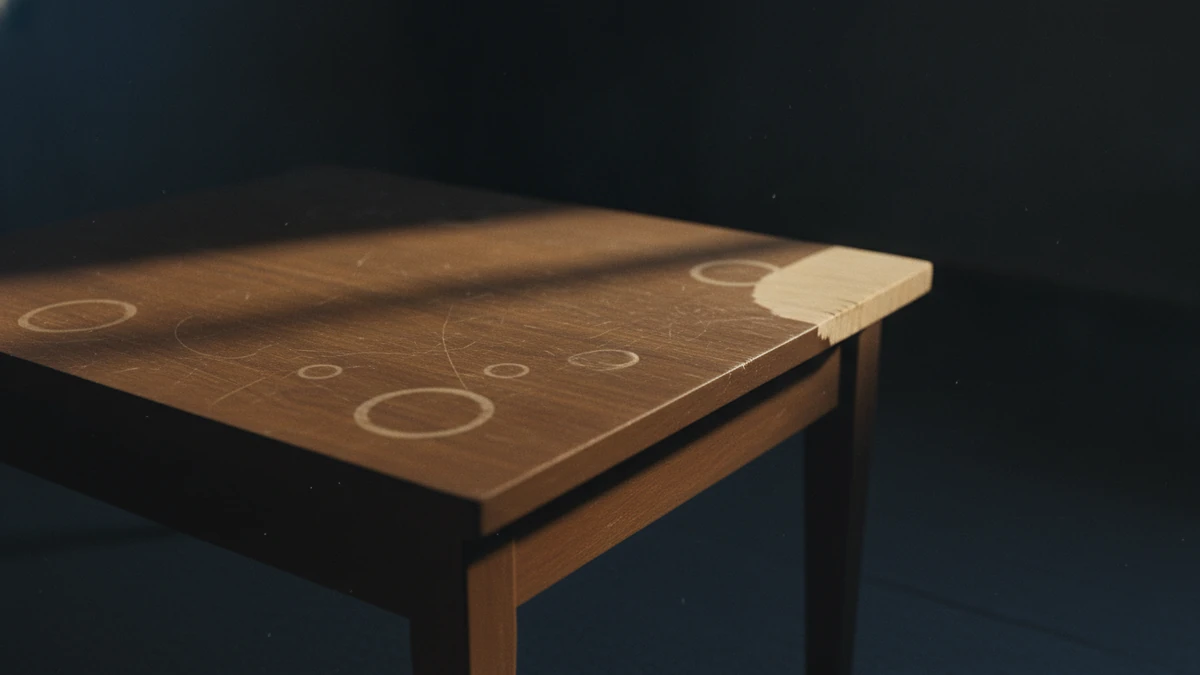
Neither of us said the rule, because neither of us knew it yet. Mine was that a thing which still works does not get replaced. Under that one, quieter and a lot older, was that the table had stood in my parents’ living room and I had done my homework on it.
What I decided hers was: that she cared more about how the room looked than about what was in it. I argued against that version all weekend. I was excellent against that version. It had one flaw, which is that I had made it up.
By then I was on the third version of my argument. The one with a budget in it. I would like it on the record that I brought a budget to a conversation about a coffee table, and that I felt quite good about myself while I did it.
So the loop never reaches the rule. It reaches the table, every single time, and stops there looking satisfied.
Why repair beats not fighting
A lot of our fighting language comes from boxing, and we borrowed the tired half. Below the belt. Throw in the towel. Come out swinging. Saved by the bell. A foul, a surrender, an opening charge, and a reprieve from the clock. All four are worn down to the point where you can say them without picturing anything at all.
But watch the end of a real fight. The bell goes, and two people who have spent ten rounds hitting each other put their arms around each other. It’s on every broadcast. It’s in none of the sayings.
Which is a shame. That’s the part with the information in it. The fight is not the verdict. The verdict is what comes after the fight.
The couples who do well still fight. What they get better at is the after. If the rulebooks are right, the fighting was never the part that could move.
That’s not just a comforting thing to say. Reviewing four and a half decades of their own lab work, John and Julie Gottman concluded that most of what couples fight about is perpetual, sitting on differences in personality or in how each person defines themselves, and in their words will never go away or be fully resolved. The goal they landed on is a dialogue you can keep having rather than a settlement [4]. And in a three-week diary study of 100 couples living together, mood and satisfaction dropped after a fight and stayed down longest for the ones slowest to get back to any kind of closeness [5].
That sounds like a soft target until you try it. A dialogue you can keep having means you can raise the subject on a Tuesday without either of you bracing at the first sentence. It means round four is shorter than round one, not louder. It means one of you can say oh good, this one again and get a laugh, and then you have it anyway, because it still needs having. That’s a real outcome and it’s available. The table gets decided, by the way, one way or the other; furniture always does. What doesn’t get decided is whose rule was right.
There’s a catch. In a study of 217 couples keeping daily diaries, how nastily they’d fought didn’t predict how much making up afterwards helped. What did predict it was whether either of them had listened during the fight [6]. The apology inherits the listening, or it inherits the lack of it.
What it’s costing while it runs
People assume the damage from a recurring argument is the argument. It isn’t, mostly. The expensive part is what the loop teaches you to do the rest of the week: you route around the subject, deciding half consciously that this one isn’t worth the hour, and the list of things you’ve let go gets long enough that it stops feeling like a list and starts feeling like the shape of the relationship.
Because every detour ends in the same silence. Silence is the part that does the damage, slowly enough that neither of you can name the week it started. You don’t wake up estranged. You wake up with a shorter list of things you say out loud. People fifteen years in can tell you exactly which topics are sealed, the way you’d describe a road closed so long the detour stopped feeling like one.

What actually shifts it
Not a better argument. If a better argument were going to work, it would have worked by round three. You’ve both got excellent arguments. That’s the problem.
What finally moved our coffee table weekend was me giving up on winning for about thirty seconds. I did not concede the table. I said it slowly, and badly, like a man reading out a language he doesn’t speak: this really matters to you, and I don’t fully get why yet.
Then I stopped talking, which was the hard part.
That’s it. Not agreement, and not surrender, which is the thing people brace for. The point stays exactly where it was. You’re conceding that their reaction is real and has a reason, and that you’d like the reason. Some people hand you the rule right there. Others can’t, because nobody ever asked them.
Three things make it land rather than sound like a technique:
- Say it before you’ve won. Offered after you’ve won, it reads as a victory lap. Offered while you still want to win, it costs something, and it registers.
- Ask about the rule, not the incident. Not “why are you upset about the table?” but “what did it mean in your house when someone changed something without asking?” Different question, different century of material.
- Then stop talking. Most people answer a question like that twice: a quick answer, and then the real one about twenty seconds later, if nobody fills the silence in between. If you’re the one who moves toward problems, filling that silence will feel like helping.
None of it requires the other person to read anything or agree to anything. You can start tonight, in the middle of the argument you were always going to have.
That isn’t wishful, though be straight about what it rests on. Researchers filmed 178 young couples having a real disagreement and scored how visibly each worked at taking the other’s point of view. The useful result is the narrow one: inside that single conversation, when one was barely trying, the other’s effort went with a better experience of it for both of them, not a worse one [7]. A correlation in one filmed conversation is not a promise about your marriage. It is the smallest useful thing anyone has shown, and your half of the loop is the one you can change without asking permission.
Before the next one
Pick the argument you can already recite. Don’t try to solve it. Answer one question about your own side, without checking whether it makes you look reasonable:
What’s the rule I’m defending, and whose house did I learn it in?
You may not get it first try. Most people name the incident before the rule, and the gap between the two is where the work lives.
Then check whether you’ve done the other half too, the way I did with the table: built a version of their rule and spent the weekend beating it. That version is always less generous than the real one. It has to be. You built it during a fight.
If that’s harder than it sounds, there’s a free two-page worksheet for it: download The Family You Came From. Six questions about the house you grew up in: how anger showed up, what got rewarded, what job you quietly took on. Not blame. Just reading rules you’ve been enforcing without ever having been shown them.
For what it’s worth, I had my own side wrong for years afterwards. I thought I was defending a budget, and I was good at defending the budget. I was defending a living room from about 1988, and that table was the last piece of it I could still put my feet on. Nobody argues about that. Nobody knows to. So you argue about the money, and you win on the money, and nothing gets better.
If you keep landing in the same place and you’d rather not work on it alone, you don’t need the other person in the room to change your half of a loop. That’s individual counselling rather than couples therapy, and for a lot of people it’s the more workable place to start.
References
- Gottman JM, Levenson RW (1999). How stable is marital interaction over time? Family Process, 38(2), 159-165. DOI:10.1111/j.1545-5300.1999.00159.x
- Staats S, Van der Valk IE, Meeus WHJ, Branje SJT (2018). Longitudinal transmission of conflict management styles across inter-parental and adolescent relationships. Journal of Research on Adolescence, 28(1), 169-185. DOI:10.1111/jora.12324
- Seedall RB (2024). Gender, attachment, and demand/withdraw patterns in the context of moderate couple conflict in cisgender, heterosexual relationships. Journal of Marital and Family Therapy, 50(4), 763-784. DOI:10.1111/jmft.12729
- Gottman J, Gottman J (2017). The natural principles of love. Journal of Family Theory & Review, 9(1), 7-26. DOI:10.1111/jftr.12182
- Prager KJ, Shirvani F, Poucher J, Cavallin G, Truong M, Garcia JJ (2015). Recovery from conflict and revival of intimacy in cohabiting couples. Personal Relationships, 22(2), 308-334. DOI:10.1111/pere.12082
- Wilder S, Prager KJ, Garapati S (2024). But I said I’m sorry: Helpfulness of romantic couples’ efforts to reconcile after conflict. Personal Relationships, 31(3), 836-854. DOI:10.1111/pere.12565
- Emond M, Ramos B, Léonard F, Péloquin K, Daspe M-E (2026). It takes two to tango: The interplay of partners’ communicated perspective-taking, positive relational experience during conflict and relationship satisfaction in young adult couples. Journal of Marital and Family Therapy, 52(3). DOI:10.1111/jmft.70149
This post is general education and is not a substitute for therapy, assessment or diagnosis. Reading it does not create a counselling relationship. The disagreement described here is my own and identifying details have been changed. If something in it matches your experience, talking to a qualified professional is the next step.