







Why You Keep Having the Same Argument
The fight that keeps coming back is rarely about the thing you are fighting about. What is actually running, why it repeats,...
Read the full article →
September 8, 2026

Evidence-based therapy that honours your faith instead of working around it. Faith-integrated Christian counselling in Victoria and online across BC, with a counsellor and former pastor who understands the terrain.
What is Christian counselling, and how is it different from regular therapy?
Christian counselling is therapy that works with your faith instead of around it. You get the same evidence-based care you would find anywhere, plus approaches built for faith. Prayer, Scripture, and lament can be part of the work whenever you want them. Introspectus Counselling offers Christian counselling with Sean Lewis, a Canadian Certified Counsellor and former pastor, in Colwood (Greater Victoria), BC and online across BC.

My name is Sean. I am a Canadian Certified Counsellor, and I got here the long way around: nine years as a pastor before this chair.
I have a master's in counselling psychology and another in divinity. The first keeps this real therapy. The second means that when faith gets hard to hold, we do not change the subject.

It does here. Booking a first session commits you to nothing except an honest conversation about what you are carrying and whether this is the right fit.
A short 15-minute call to discuss your goals, no commitment.
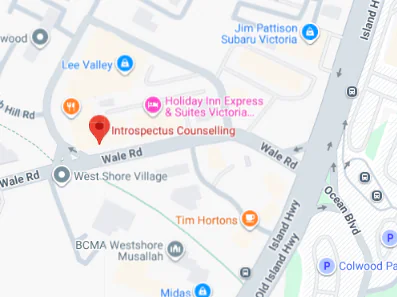
132-328 Wale Rd, Colwood, BC V9B 0J8
Phone: 250-556-4623
Email: sean@introspectuscounselling.ca
Six examples of where faith and the clinical work meet, not a list of what I treat.

People keep telling me to be grateful, and I am not.
Grief work makes room for the whole weight of a loss rather than tidying it into something easier to be around.
Try the lament worksheetYour tradition already built a form for this. Lament speaks to God directly, states the complaint without softening it, and asks for something, all without pretending. It gives grief somewhere to go while you wait for gratitude to be honest again.
Something happened in a place I trusted, and I do not know who I am now.
This is not the same as post-traumatic stress. Trauma work addresses fear and the body's alarm; this is an injury to conscience, meaning and trust.
Counselling for people of faithIt has a name, moral injury, and where the wound involves God or a church, spiritual injury. A treatment protocol has been built for exactly this, and the theological questions belong in the room rather than being set aside until later [9].
I confess the same thing over and over and it never comes clean.
Checking and re-confessing that brings a few minutes of relief and then returns stronger is a recognised pattern with a name and a treatment.
About intrusive thoughts and ruminationA tender conscience and religious obsessive-compulsive disorder, sometimes called scrupulosity, are not the same thing, and telling them apart changes what helps. A tender conscience belongs to someone who takes their faith seriously, and reassurance settles it. The other is a loop that borrows your conscience's voice, and reassurance keeps it running rather than quieting it. Knowing which one you are dealing with is itself a relief, and it is knowable [8].
I keep waiting to feel sure, and the decision will not wait.
Rather than waiting for certainty that may not arrive, the work looks at what you actually value and what a workable next step would be.
Try Without Being Sure, the discernment toolFor you the question is rarely only what you want; it is what you are for. Calling, vocation and obedience are part of the material. We work with the shape of the pull itself, and find one faithful step you can take without needing the whole map first.
I was told to forgive, and I cannot get there.
The work separates the decision to stop seeking payback from the much slower change in how you feel about it. You are not failing when the feeling lags behind the decision.
In church those two often arrive as one instruction, with reconciliation folded in as though it were the same act. It is not. A five-step model tested in randomised trials treats forgiving and reconciling as separate choices, and reconciling stays yours to decline when it would not be safe [6, 7, 10].
I was not sure whether God belonged in this conversation.
The therapy is ordinary therapy, held to the same standards as anywhere else. Faith is welcome inside that work, and there is published guidance on doing it well [3].
How I got hereI trained in both. A master of divinity sits beside the counselling degree, so when the conversation turns to God we can stay with it.

Question 1 / 4
What is pressing hardest right now?
Question 2 / 4
When you picture the help you want, it looks like:
Question 3 / 4
Has this started to affect how you function day to day?
Question 4 / 4
Would a receipt for your insurance matter?
What you are describing sits in clinical territory: symptoms, functioning, and a plan for change. That is the work I do as a Canadian Certified Counsellor, and your faith is welcome in it.
Ask a question firstWhat you are describing sounds like spiritual care rather than clinical treatment. A pastor or spiritual director fits that, and most churches offer it at no cost. That is often the right place to start, and you do not need a therapist for every hard season.
Free and low-cost supportsYou are describing something on the seam. Nine years of pastoral ministry sit behind my MDiv, so the spiritual side of this does not get referred out. What makes it different from a pastor is what it is: psychotherapy, done as structured clinical work, and most extended health plans cover it; coverage varies, so check yours.
What insurance covers| A therapist | A pastor | |
|---|---|---|
| What it is for | Understanding what keeps repeating, and changing it in ways you can measure. | Being formed, worshipping, and belonging to a people over years. |
| What an hour looks like | Naming where it hurts, agreeing what to work on, then checking it is shifting. | Prayer, Scripture, a word of counsel, and the rites your tradition keeps. |
| Accountability | A national certifying body, a code of ethics I answer to, and confidentiality limits set by BC law. | A congregation, a board, or a denomination that knows them. |
| Cost | A fee, with a receipt many extended health plans accept. | Usually free, offered as part of the life of the church. |
| Where I sit | This is the chair I sit in now, and the one you book here. | I sat in that chair for nine years, so the questions do not end the conversation. |
Your privacy is paramount. I hold to rigorous professional standards so that sessions stay confidential and comfortable. Appointments run in person in the Greater Victoria area at the Colwood office, and by secure video anywhere in British Columbia.
See the office and directions →The work is informed by evidence-based and trauma-aware approaches, while staying flexible and responsive to you rather than to a diagnosis. I draw on cognitive, acceptance-based, trauma-informed, mindfulness, and relational frameworks.
How CBT works →I work with adults experiencing stress and burnout, anxiety, depression, trauma and PTSD, grief and loss, relationship difficulties, and family-of-origin concerns. Sessions are collaborative, paced, and grounded in safety.
Who I work with →
Nothing strange. It is a conversation, and you set the pace.
Mostly listening. Nothing is decided that day.
Some people open with Scripture, some never mention it. Both are normal.
I will ask once, then follow your lead.
Hard things get told when you are ready. Going slowly is allowed.
Confidential, within the limits BC law sets. I name them before we start.
You do not need a crisis of faith to be here. Most people come for something ordinary and hard, and simply do not want to explain or defend their faith while they work on it.

When home feels distant, and the commitment still matters to you.
Explore Relationships
When you are running on empty and still showing up for everyone.
Explore Stress & Burnout
When thoughts arrive that frighten you, and shame follows them.
Explore Intrusive Thoughts
When the family you came from still shapes how you believe.
Explore Family of Origin Work
When the questions will not quiet, or church is where you got hurt.
Explore Spiritual & ExistentialYes, anywhere Canadian Certified Counsellors are covered.
 Canada Life
 Co-operators
 Coughlin & Associates
 CVAP
CVAP
 Dialogue
 Empire Life
 Equitable Life
 UV Insurance
 GMS
GMS
 Green Shield Canada
 iA Financial Group
 ICBC
ICBC
 Johnston Group
 Manulife
 Pacific Blue Cross
 Sun Life
 TELUS Health
 Medavie Blue Cross
 People Corporation
 ProviderConnect
 RWAM
RWAM
 Simply Benefits
Two ways. Your faith is welcome instead of politely set aside, and there are approaches built for faith that a general therapist will not have. You can pray in session, work with Scripture, or carry grief through lament, alongside the same evidence-based care you would get anywhere.
Yes, and it is not a lesser or softer option. Reviews of the research find that therapy which integrates a client's faith performs at least as well as standard treatment, and often does more for the spiritual side of what someone is carrying [1]. A randomised trial of religiously integrated cognitive behavioural therapy found it worked comparably to the conventional protocol [2]. Handling faith well in the room is a recognised clinical competency, with training and published guidance behind it [3].
Yes, whenever they are useful to what you are working on. Some clients pray in session. Others never do. Both are completely normal.
Yes. Sessions run in person in Colwood, and by secure video anywhere in British Columbia. A lot of clients mix the two depending on the week.
No. My job is to help you get clearer on your own faith and values, not to hand you mine. That is not just a preference; protecting your autonomy is part of my code of ethics as a Canadian Certified Counsellor.
Doubt is welcome here. Research finds that doubt handled honestly, with support, tends to steady people, while doubt carried alone and in shame tends to wear them down [5]. The goal is honesty, not a conclusion I have picked for you.
No. This is for anyone who wants their Christian faith honoured in the work, whether you are deeply involved in a faith community or working things out on your own right now.
Yes. Much of that work is separating a healthy conscience from toxic shame, the kind that tells you that you are the problem rather than that you did something you can put right.
Yes. Spiritual struggle is a real and studied part of mental health [4]. It can be worked through while your faith stays yours to keep, rather than something you have to throw out in order to heal.
Christian counselling is faith-integrated therapy; the frame is clinical, and your faith is welcome and useful inside it. Pastoral counselling comes from the other direction, as care rooted in ministry and spiritual formation. I offer both, because some seasons call for a therapist and some call for a pastor.
Read about pastoral counselling →Longer reads from the blog, written and clinically reviewed by Sean.
The fight that keeps coming back is rarely about the thing you are fighting about. What is actually running, why it repeats,...
Why unwanted thoughts come back louder when you fight them, what loosens the loop instead, and how to tell a scary thought...
Therapists took depression treatment apart to find what was working. The answer sounds like something the Psalms have said for three thousand...

Three more places on this site, depending on what you actually need.
 People of Faith
For pastors, ministry leaders, and people whose life is bound up with a church.
Counselling for faith communities →
People of Faith
For pastors, ministry leaders, and people whose life is bound up with a church.
Counselling for faith communities →
 Spiritual and Existential Exploration
When the questions run past a Christian frame: meaning, mortality, purpose.
Explore meaning and purpose →
Spiritual and Existential Exploration
When the questions run past a Christian frame: meaning, mortality, purpose.
Explore meaning and purpose →
 Pastoral Counselling
Care that starts from ministry rather than the clinic, rooted in spiritual formation.
Ministry-rooted care →
Pastoral Counselling
Care that starts from ministry rather than the clinic, rooted in spiritual formation.
Ministry-rooted care →