

The gentlest people get the ugliest thoughts. Ask around, carefully, and you’ll see the pattern: the new dad who adores his daughter gets a flash of dropping her on the stairs. The nurse gets one at the medication cart. The believer, mid-prayer, gets a sentence so foul she won’t repeat it to anyone, ever. None of them wanted the thought, and every one of them concluded, privately, that it meant something rotten about who they are.
There’s a name for these visitors, and the name is intrusive thoughts. They are the words and the images and the urges and the what-ifs that you didn’t want, and that barge in without knocking. If you’ve ever typed how to stop intrusive thoughts into a search bar, this post is for that search: why the fight keeps failing, what loosens the loop instead, and what an old psalm knew before any lab did. And if the loop already has claws in you, counselling for intrusive thoughts and rumination exists for exactly this; you don’t need to earn your way in by getting worse.
Before anything else: an intrusive thought isn’t a plan, a wish, or a preview of what you’ll do. Hold on to that. We’ll come back to why the claim holds.

On this page
Almost everyone gets them
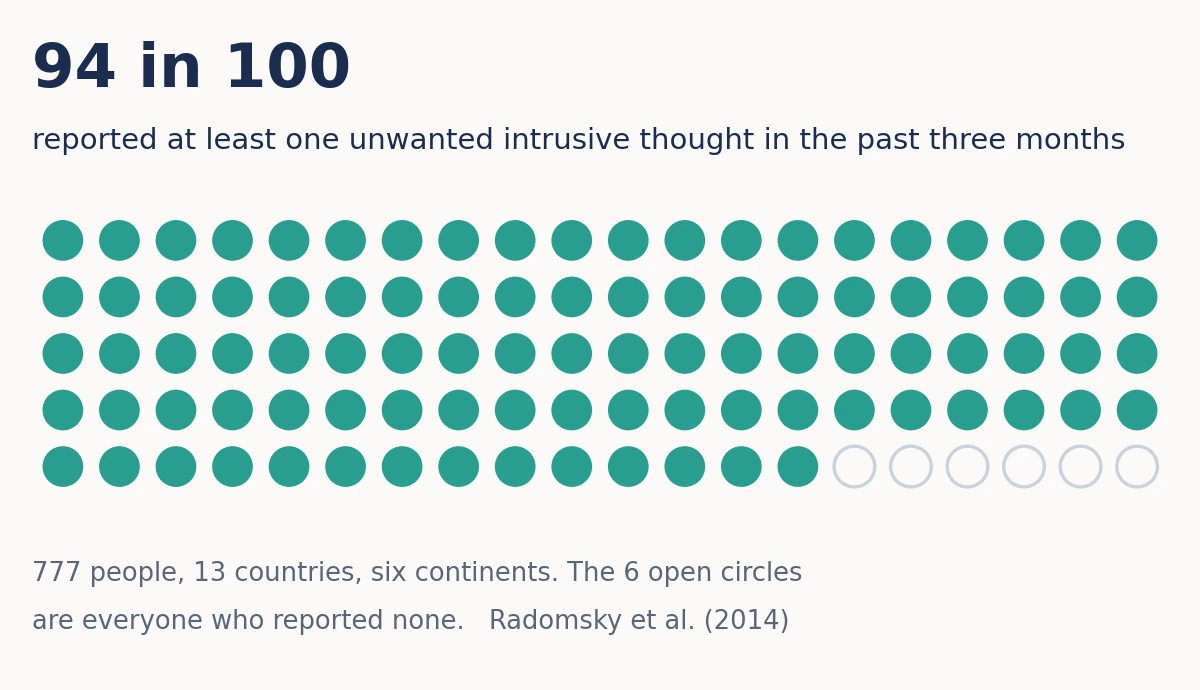
Researchers once put a blunt question to 777 university students in 13 countries, on six continents: in the past three months, has a thought you didn’t want shown up anyway? About 94 in every 100 said yes [1]. Not 94% of people who were already in treatment. Just students, worried about their exams and their rent. The other six per cent, I assume, were having a much better week than the rest of us.
That number matters, because most people who are frightened of their own thoughts are working from a different theory. They assume a normal mind doesn’t produce this stuff at all. It does, though. All the time, and just about everywhere anyone has gone looking. The doubting kind topped the list: did I lock it, did I offend them, is the stove on. The darker kinds, the violent and sexual and blasphemous ones, were rarer, but they still showed up everywhere the survey went [1]. Your mind isn’t malfunctioning when it coughs one up. It’s doing the ordinary thing.
There’s a word for the way these ones land, and the word is ego-dystonic. It means the thought cuts against what you actually want, and that’s the bit that stings. If it lined up with what you wanted, it wouldn’t feel like something breaking in. It would just feel like you. So the horror is doing a job. It’s telling you where your lines are.
It’s a strange thing, being reassured by your own disgust. At three in the morning, that’s not nothing.
The white bear problem
So why can’t you just stop thinking it? In 1987 a psychologist named Daniel Wegner sat people down and had them say their thoughts out loud for five minutes. Some of them got one extra rule: don’t think about a white bear. He put a bell on the table, and the instruction was that every time the bear turned up anyway, you ring it. The bell kept ringing. Five minutes of grown adults, ringing a bell at a bear that wasn’t there.
Then he lifted the ban. Everybody got a second five minutes, and this time the bear was allowed. The people coming off the ban rang it more than the ones who had not been told to suppress anything yet [2]. The bear that had been banned came back, and it came back with interest.
Run it yourself if you like. Sixty seconds, no white bear. You’ll catch the machinery doing its work: to keep a thought out, your mind has to keep checking whether the thought is in. And the check is the thought. So the push becomes a check. The check brings back the bear. The bear proves the push is failing. And the failing push asks for a harder push, which is where you came in.
Other people kept running it. Years of it. And then somebody went and added up the careful ones, the versions that had a group to compare against, and the picture that came out was more modest than the first study had made it look [3]. The bear does come back after a ban. How much of it comes back depends on the thought, and on who is doing the counting, and the honest answer is a bit rather than a lot. Small, then. But small in the wrong direction, and it’s the first thing almost everyone tries. Pushing a thought away isn’t neutral. It’s a bet that loses a little every hand, all night, forever.
So why does anyone keep making that bet? Think about the passenger seat. Most of us feel safer driving than being driven, even when the other person is the better driver. Ask around, and almost nobody says they’re the one more likely to crash. The road hasn’t changed. Only the hands have. We treat being in control as the same thing as being safe, and once you see that, what you do at three in the morning stops looking stupid. Fighting the thought is grabbing the wheel. It’s the one move that feels like doing something. And that’s why a strategy that loses every hand keeps getting played every night.
There’s an old Korean proverb that gets there a good deal faster than the lab did. dalgui mogeul biteureodo saebyeogeun onda. You can strangle the rooster, and the dawn will come anyway. The rooster was never making the morning, and your grip was never what decided whether the thought came to visit. All that the grip has ever bought you is a sore hand.
You don’t fight the thought because it’s strong. It’s strong because you fight it.
Why the ugly ones pick on you
Two people can get the same flash on the same staircase. One thinks, huh, brains are weird, and is on to the next thing by the bottom step. The other stops cold and opens an investigation: why did I think that, what kind of person thinks that, what if it means I’d do it. Same thought. Different verdicts. And in the research, it’s the verdict, not the thought, that predicts who gets stuck [4].
Stanley Rachman spent most of his career on this, and his answer was simple. A thought only turns into an obsession when you start reading it as proof of what you are. If you read it that way less, it starts to loosen [4]. So it’s not the content of the thought that keeps the thing going. It’s what you’ve decided the content means.
One piece of that has its own name: thought-action fusion. It’s the feeling that thinking a thing is nearly as bad as going and doing it, or that thinking about it somehow makes it more likely to happen. If you feel that strongly enough, then every dark flash turns into something you have to look into. And the looking into it keeps it alive. You check, and you feel better for about a minute, so you check again, and the relief has just taught you the thought was worth checking. It runs on the same alarm system as anxiety.
Somewhere around here you may be assembling the objection: fine for someone whose worst thought is about the stove, but mine is different. Mine is disgusting. If you knew mine, you’d stop writing calm paragraphs. The research answers that, and it answers with strange precision: these thoughts land where they cost the most. The gentle parent gets the harm flash, the careful driver gets the swerve, the person who’d rather die than blaspheme gets the blasphemy mid-prayer. The more it disgusts you, the further away it sits from anything you’d ever choose. A plan has your fingerprints all over it. There are steps to it, and there’s intent, and there’s some part of you pulling towards it. An intrusive thought has none of that. It just lands where you’re softest.
Loosening your grip
If the fight feeds it, the answer isn’t to like the thought, or agree with it, or lie down under it. It’s to stop pulling.
Quicksand is the image I keep coming back to, and it’s a standard one in this kind of therapy. Everything in you says fight. Fighting is what welds you in place. The thing that works is the move every instinct in you objects to. Stop thrashing. Lean back. You were always going to float, because the sand is denser than you are. The thrashing was costing you the way out.
Same in your own head. The struggle is what keeps you stuck.

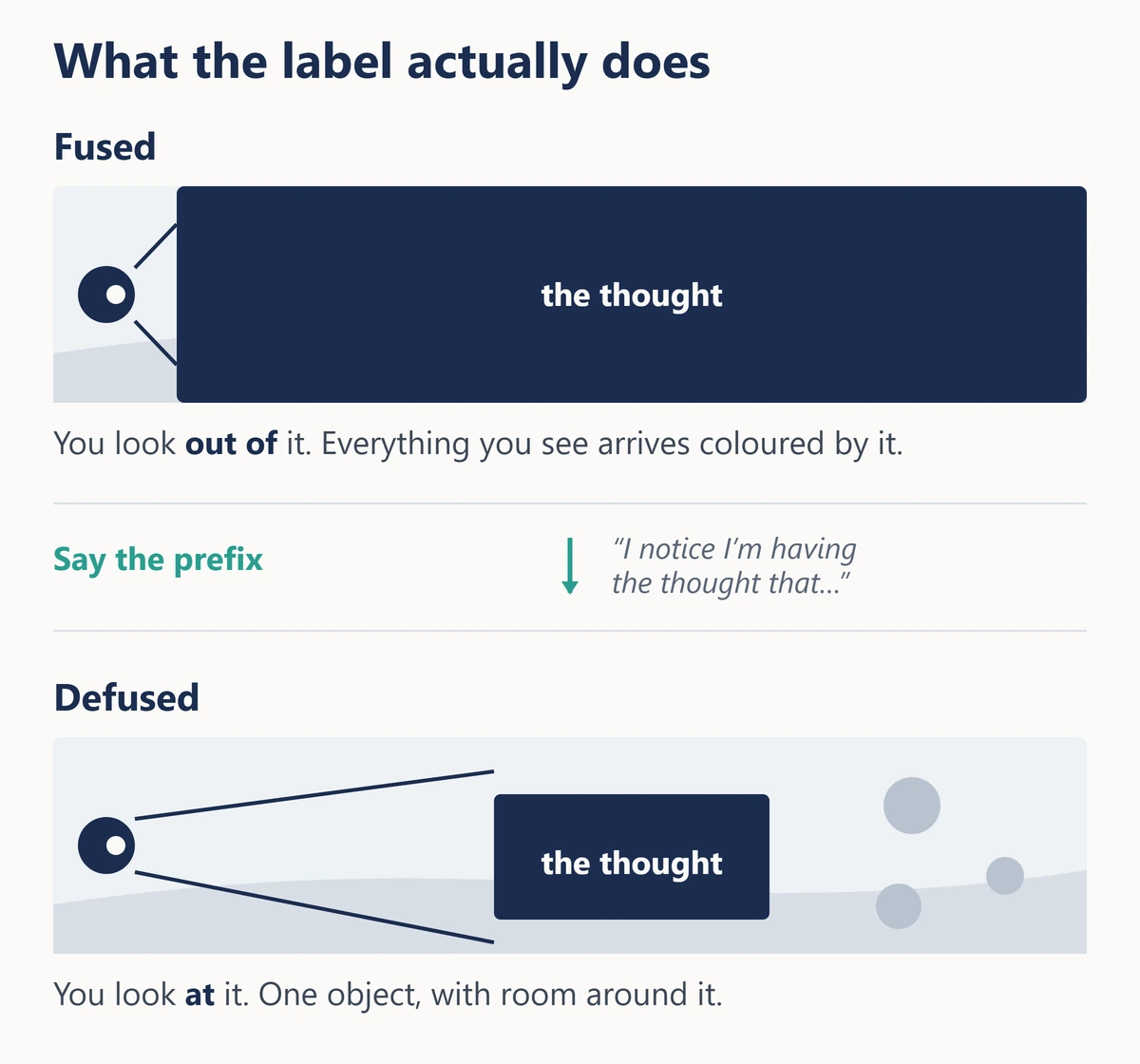
Acceptance and commitment therapy starts you with one small move, and it’s an almost embarrassingly wordy one. You put a label on the front of the thought: I notice I’m having the thought that… Say the whole clunky prefix out loud. It moves you back a step, from looking out of the thought to looking at it.
There’s a blunter version, and it’s about ninety years old. Take the one word doing the damage and say it out loud, over and over, for thirty seconds. Somewhere in there it stops being a word and turns into a noise. In one study people did exactly that, and afterwards the thought was bothering them less and they were believing it less. It did better than distracting yourself, and it did better than trying to shove the thought away [5]. The meaning drains off it, and you’re left with the sound. That happens to any word you repeat. It only matters for the words that cost you something.
For the thoughts you’d rather not repeat even to yourself, put the label on the category instead of on the content. Ah, the harm one is back, noted. And then, and this is the step that people skip, you go back to whatever it was you were doing that matters to you. Making dinner. Reading to your kid. Praying, if that’s what you were doing. The thought rides along for a bit, unanswered, and a thought you leave unanswered gets easier to carry.
Now the hard part. If this is eating an hour of your day, or driving rituals you can’t skip, or quietly reshaping your week around avoiding it, then that’s further along than a blog post should be taking you. Go and get it looked at. For OCD there’s a treatment with a long track record, exposure and response prevention, where you practise facing the thought and not doing the ritual [6]. Not because you’re broken. Because at that strength it doesn’t give way to trying harder, and there are people who do this for a living.
Take this further: Download the Rumination Interrupt Card, a wallet-sized three-step interrupt for the moments when the loop starts and you can’t remember what to do.
Take every thought captive?
If you grew up in church, a verse has probably been circling this whole post: “taking captive every thought to make it obedient to Christ” (2 Corinthians 10:5, NIV). I’ve heard it used as a kind of patrol order for the mind, as if the job were to arrest every bad thought on sight and hold it down until it confesses. But go and read the chapter around it. Paul’s demolishing “arguments and every pretension that sets itself up against the knowledge of God”; it’s siege language, and it’s about public claims in a running argument. That’s a long way from being a rule for the 3 a.m. weather of a tired mind. The verse deserves better than being turned into a rule for policing your own head. That’s the one approach the research says will bring the thought back, and your own last six months probably say the same.
Scripture’s own instinct for anxious thoughts runs the other way. David’s prayer isn’t “keep them out”. It’s “come and see them”:
Search me, God, and know my heart; test me and know my anxious thoughts.
Psalm 139:23, NIV
Notice what he doesn’t ask for. Not that the anxious thoughts be taken away, or kept out, or never mentioned again. He asks God to come and look at them. Whatever else that prayer is doing, it’s not a man trying to keep the contents of his own head out of sight.
It’s an old story for the people of God. The people walk out of Egypt, and Egypt keeps strolling through their heads long after they’ve gone. The chains were off them, and their minds went back all the same. But notice where the trouble actually landed. It wasn’t that they missed the food they used to have there. It was the day the missing turned into a plan, barely two years out, when they got together and proposed picking a leader and going back (Numbers 14:4, NIV).
That difference, between just having a thought and actually going along with it, is the one to hang on to. You can think something without believing it, even when it turns up with all the confidence of a belief. Thoughts arrive sounding certain. That’s how they’re delivered, and it’s not a report on what you actually hold.
One more group, and I want to speak to them directly. For some people the intrusions take the faith itself as their target: blasphemous flashes mid-prayer, confession that never feels finished, a conscience that has started keeping a file on you. That pattern has a name, scrupulosity, and it’s well understood [6]. It responds to the same treatment obsessive-compulsive disorder does, and having it says nothing about whether your faith is real. If that’s your corner of this, Christian counselling can hold the clinical work and the faith in the same room, instead of asking you to pick one.
If you are in crisis or thinking about ending your life, call or text 9-8-8 (Canada), any hour. For immediate danger, call 911 or go to your nearest emergency department.
And one thing to be clear about. An intrusive image of harming yourself, one that frightens you and that you don’t want, is not the same thing as wanting to die. But if what you’re carrying is heavier than that, or you honestly can’t tell which one you’re holding, don’t sort it alone; the 9-8-8 line, your family doctor and a trusted person in your life are all fair first calls.
One last thing, if you want it. Without scrolling back: why does a mind have to check for a banned thought in order to ban it, and what happens to someone who thrashes in quicksand?
If the loop has been winning, the problem was never that you failed to push hard enough. I work with people on exactly this, in person in Colwood and across the West Shore, and online across BC. Bring the thought you won’t repeat. It’s welcome in the room, and it won’t be the worst one the room has heard.
Educational content; not a substitute for therapy. If you’re working through something significant, consider connecting with a counsellor or your family doctor.
References
- Radomsky AS, Alcolado GM, Abramowitz JS, et al. (2014). Part 1. You can run but you can’t hide: Intrusive thoughts on six continents. Journal of Obsessive-Compulsive and Related Disorders, 3(3), 269-279. DOI:10.1016/j.jocrd.2013.09.002
- Wegner DM, Schneider DJ, Carter SR, White TL (1987). Paradoxical effects of thought suppression. Journal of Personality and Social Psychology, 53(1), 5-13. DOI:10.1037/0022-3514.53.1.5
- Abramowitz JS, Tolin DF, Street GP (2001). Paradoxical effects of thought suppression: A meta-analysis of controlled studies. Clinical Psychology Review, 21(5), 683-703. DOI:10.1016/S0272-7358(00)00057-X
- Rachman S (1997). A cognitive theory of obsessions. Behaviour Research and Therapy, 35(9), 793-802. DOI:10.1016/S0005-7967(97)00040-5
- Masuda A, Hayes SC, Sackett CF, Twohig MP (2004). Cognitive defusion and self-relevant negative thoughts: Examining the impact of a ninety year old technique. Behaviour Research and Therapy, 42(4), 477-485. DOI:10.1016/j.brat.2003.10.008
- Abramowitz JS, Jacoby RJ (2014). Scrupulosity: A cognitive-behavioural analysis and implications for treatment. Journal of Obsessive-Compulsive and Related Disorders, 3(2), 140-149. DOI:10.1016/j.jocrd.2013.12.007